

Kitchen science experiment kits combine food, simple chemistry, and hands-on activities, but they differ in how much they teach, how much is edible, and how much setup they require. I rank the KiwiCo Science of Cooking Bundle as best overall for its focused ice cream and mini-cake projects, while the Playz Edible Candy Making Kit stands out for variety and the KiwiCo Ice Cream STEM Kit offers a simpler starting point for younger kids. The main tradeoff is between a small number of guided cooking projects and a larger mix of experiments that may need more adult help or household ingredients. Age range, edible results, cleanup, and repeatability can matter as much as the experiment count. Read on for the full breakdown and help matching a kit to your child’s interests.

Prime made for students and young adults
- Fast, free delivery for dorm and study essentials
- Prime Video and Amazon Music included
- Member-only deals
Key Takeaways
- The KiwiCo Science of Cooking Bundle earns the overall lead by pairing two distinct food projects, making it a stronger choice for families who want more than a single-topic kit.
- Playz offers the broadest activity range with 40+ experiments, though a high count does not automatically mean each activity is equally food-focused or easy to repeat.
- The KiwiCo Ice Cream STEM Kit is the clearest beginner pick for younger children who are drawn to one familiar, hands-on result rather than a varied experiment set.
- The two 4M kits serve different expectations: the Steam Powered Kids version leans into playful kitchen-themed science, while the six-experiment kit offers a more defined activity count for ages 8 and up.
- MindWare’s Bubble Barista Kit has the most distinctive theme for kids interested in drink textures and bubbles, but it is less suited to shoppers seeking broad cooking-science coverage.
| KiwiCo Science of Cooking Bundle: Ice Cream and Mini Cakes Kits |  | Best for Food-Based Learning | Brand: KiwiCo | Recommended age: 5 years and up | Number of kits: 2 | VIEW LATEST PRICE | See Our Full Breakdown |
| 4M Steam Powered Kids Kitchen Science Kit |  | Best for Experiment Variety | Brand: 4M | Recommended age: 8 years and up | Experiments: Over 30 | VIEW LATEST PRICE | See Our Full Breakdown |
| 4M Kitchen Science Kit, 6 Experiments for Kids Ages 8+ |  | Best Compact Starter Kit | Brand: Toysmith | Model: 3806 | Recommended age: 8–15 years | VIEW LATEST PRICE | See Our Full Breakdown |
| MindWare Kitchen Science Academy Bubble Barista Kit |  | Best for Drink Science | Brand: MindWare | Recommended age: 8 years and up | Set name: Bubble Barista Kit | VIEW LATEST PRICE | See Our Full Breakdown |
| Playz Edible Candy Making Science Kit for Kids, 40+ Experiments |  | Best for Candy-Making Variety | Brand: Playz | Recommended age: 8–12 years and up | Experiments: 40+ | VIEW LATEST PRICE | See Our Full Breakdown |
| KiwiCo Science of Cooking Ice Cream STEM Kit for Ages 5+ |  | Best for Hands-On Ice Cream Science | Brand: KiwiCo | Age range: 5–12 years | Manufacturer recommended age: 5–11 years | VIEW LATEST PRICE | See Our Full Breakdown |
| kitchen science experiment kit | Brand | Recommended age | Experiments | Item dimensions |
|---|---|---|---|---|
| KiwiCo Science of Cooking Bund | KiwiCo | 5 years and up | — | — |
| 4M Steam Powered Kids Kitchen | 4M | 8 years and up | Over 30 | 14.84 x 11.22 x 2.56 inches |
| 4M Kitchen Science Kit | Toysmith | 8–15 years | 6 | 8.5 x 2.5 x 6.75 inches |
| MindWare Kitchen Science Acade | MindWare | 8 years and up | — | — |
| Playz Edible Candy Making Scie | Playz | 8–12 years and up | 40+ | 15 x 11.5 x 3.3 inches |
| KiwiCo Science of Cooking Ice | KiwiCo | — | — | — |
More Details on Our Top Picks
KiwiCo Science of Cooking Bundle: Ice Cream and Mini Cakes Kits
Two kinds of kitchen science make this bundle a strong fit for children who learn best by making something they can eat. The ice cream kit pairs experiments with recipes for sorbet and two ice cream flavors, while the cake kit puts baking and decorating into the same activity with six mini cakes. Compared with the KiwiCo Science of Cooking Ice Cream STEM Kit, this bundle adds baking tools and a second project rather than focusing only on frozen treats. The digital scale, cake pan, and decorating pieces also give kids a chance to practice measuring and finishing techniques.
The tradeoff is a more involved kitchen session: families supply ingredients, and cooking or baking calls for adult help, especially for younger children. Choose this over the 4M Steam Powered Kids Kitchen Science Kit when edible results matter more than a broad mix of quick demonstrations; skip it if you want experiments that need little preparation.
Pros:- Pairs frozen-treat experiments with a separate baking and decorating project.
- Includes recipes for sorbet, vanilla ice cream, and chocolate ice cream.
- Cake tools include a digital scale, flexible pan, and decorating supplies.
- Offers a screen-free activity with practical measuring and cooking steps.
Cons:- Families must provide ingredients beyond the included kit components.
- Cooking and baking require adult supervision for younger children.
- The two projects can take more kitchen time and preparation than a compact experiment kit.
Best for: Families with children five and older who want guided cooking activities that combine food science with edible results.
Not ideal for: Caregivers seeking a low-prep, ingredient-free kit or an activity children can complete without adult supervision.
- Brand:KiwiCo
- Recommended age:5 years and up
- Number of kits:2
- Ice cream activities:Experiments and recipes for lemon sorbet, vanilla ice cream, and chocolate ice cream
- Mini cake activities:Bake six mini dome cakes and decorate them as frogs, penguins, pandas, or roses
- Ice cream kit components:Scoop, whisk, large and small cans, clear jar, towel, measuring cups, lab notebook, and recipes
- Mini cakes kit components:Cake pan, sifter, two decorating bags, piping tip, two twist ties, digital scale, and illustrated instruction booklet
- Manufacturer part number:SOC-AMZ-F3034
Our verdict“Choose this bundle for children who want to explore food science through both frozen treats and decorated mini cakes, provided an adult can help with kitchen work.”
4M Steam Powered Kids Kitchen Science Kit
More than 30 activities give this kit the widest-ranging experiment menu here, from a fruit-powered clock to a bottle fountain and a small water-cycle model. Its kitchen connection is broader than cooking: children use familiar materials to explore chemistry and physics, with the 24-page instruction book explaining the ideas behind the activities. Compared with the 4M Kitchen Science Kit, 6 Experiments for Kids Ages 8+, this option offers many more listed experiments and a wider set of science concepts, rather than centering on a handful of classic demonstrations.
That breadth comes with a preparation tradeoff. Some activities call for household items that are not supplied, and the cardboard components are less focused on making food than the Playz Edible Candy Making Science Kit. I’d pick 4M for curious children who want variety and explanations, but not for families specifically seeking recipes or edible projects.
Pros:- Offers more than 30 hands-on activities across several science topics.
- The 24-page guide explains the principles behind the experiments.
- Uses familiar household items to connect science with everyday life.
- Includes activities such as a fruit-powered clock and bottle fountain.
Cons:- Some experiments require household supplies that are not included.
- The activities focus on general science demonstrations rather than preparing food.
- The cardboard material may be less suited to repeated exposure to kitchen spills.
Best for: Families with children eight and older who want a broad menu of kitchen-adjacent chemistry and physics activities with written explanations.
Not ideal for: Children primarily interested in cooking, candy making, or experiments that include every required household material.
- Brand:4M
- Recommended age:8 years and up
- Experiments:Over 30
- Instruction book:24 pages
- Educational focus:Science, chemistry, and physics
- Material:Cardboard
- Item dimensions:14.84 x 11.22 x 2.56 inches
- Item weight:0.23 kg
- Language:English
Our verdict“Pick this for an older child who wants the broadest selection of explained experiments, not for a food-making-first experience.”
4M Kitchen Science Kit, 6 Experiments for Kids Ages 8+
Six recognizable experiments make this a straightforward introduction to kitchen science: children can generate electricity with a lemon, launch a vinegar-powered rocket, and write invisible messages. The kit’s small footprint suits a limited storage space, and its activities use common supplies rather than specialized equipment. Compared with the 4M Steam Powered Kids Kitchen Science Kit, it offers a shorter, more focused set of demonstrations instead of a menu of more than 30 activities. That can make it easier to choose a first project, though it also limits how much variety families get from one kit.
Expect to gather ingredients and tools yourself, including vinegar, baking soda, measuring items, and a lemon. Unlike the KiwiCo Science of Cooking Bundle, this is not a recipe-centered activity with edible outcomes; it is better suited to quick STEM demonstrations. I’d skip it if you want a kit with most materials included or food preparation as the main event.
Pros:- Includes six hands-on experiments, including a lemon-powered electricity activity.
- Compact dimensions make the kit easy to store between projects.
- Uses common household ingredients and tools.
- Instructions accompany the experiments.
Cons:- Required ingredients and tools are not included.
- Six activities provide less variety than the 4M Steam Powered Kids Kitchen Science Kit.
- The experiments emphasize demonstrations rather than cooking or edible results.
Best for: Families with children ages 8–15 who want a compact, low-complexity introduction to hands-on chemistry and STEM demonstrations.
Not ideal for: Buyers who want an extensive activity library, included ingredients, or cooking projects that produce food to eat.
- Brand:Toysmith
- Model:3806
- Recommended age:8–15 years
- Experiments:6
- Educational focus:STEM and chemistry
- Included components:Science kit and experiment instructions
- Additional supplies required:Vinegar, baking soda, red food coloring, dishwashing liquid, measuring cup, sugar, clothespins, teaspoon, forks, cornstarch, grape juice, and lemon
- Item dimensions:8.5 x 2.5 x 6.75 inches
- Item weight:5.6 ounces
Our verdict“Choose this compact kit for a small set of classic science demonstrations if you are comfortable gathering the supplies separately.”
MindWare Kitchen Science Academy Bubble Barista Kit
Spherification through drinks gives this kit a distinctive niche: children make fizzy, flavored beverages and can experiment with color and flavor combinations. The pitcher, cups, measuring tools, and recipe book make it feel more like a dedicated drink-making activity than the broader demonstration sets from 4M. Compared with the Playz Edible Candy Making Science Kit, it concentrates on beverage experiments instead of several kinds of candy, so it suits kids who are drawn to drinks and presentation rather than a large assortment of sweets.
The main limitation is a meaningful one: sodium alginate and calcium lactate are sold separately, so the included accessories alone are not enough to carry out the signature process. It is also aimed at ages eight and up. I’d choose it for a child interested in how drinks form bubbles and spheres, but prefer the KiwiCo Science of Cooking Bundle if baking and frozen treats are a better fit.
Pros:- Introduces spherification through hands-on beverage making.
- Supports experimentation with custom colors and flavors.
- Includes a recipe book with step-by-step drink instructions.
- Supplies a pitcher, cups, measuring tools, straws, and a jar.
Cons:- Sodium alginate and calcium lactate must be purchased separately.
- Designed for children ages eight and up.
- Its beverage focus offers less variety than kits covering multiple food types.
Best for: Families with children eight and older who want a guided, customizable drink-making activity focused on spherification.
Not ideal for: Buyers who want a ready-to-start kit with all key ingredients included, or children more interested in baking and candy than drinks.
- Brand:MindWare
- Recommended age:8 years and up
- Set name:Bubble Barista Kit
- Item type:Food science kit
- Included components:Bubble Barista unit with bubble lid, pitcher, and base; measuring spoons; measuring cup; jar; two cups; two straws; recipe book
- Additional ingredients required:Sodium alginate and calcium lactate, sold separately
- Number of items:1
- Manufacturer part number:14122202
Our verdict“Choose this for an older child excited by drink experiments and customizable flavors, as long as you can source the two required ingredients separately.”
Playz Edible Candy Making Science Kit for Kids, 40+ Experiments
Candy is the lesson and the payoff in this kit, which covers gummies, jelly, rock candy, chocolate, and hard candies across more than 40 experiments. Its 32-page illustrated activity and lab guide gives children a substantial set of projects to work through, while more than 21 tools and ingredients mean it arrives with more activity materials than the compact 4M Kitchen Science Kit, 6 Experiments for Kids Ages 8+. Compared with the KiwiCo Science of Cooking Bundle, Playz leans much more heavily toward candy variety rather than balancing frozen desserts with baking and cake decorating.
The range is appealing, but some projects still call for extra household supplies, and candy-making can involve steps that need adult oversight. The supplied tools and ingredients also mean this is a larger, heavier kit than 4M’s six-experiment option. I’d choose Playz for children keen on sweets and repeated projects, not for families wanting a small, quick setup.
Pros:- Offers more than 40 candy-making experiments.
- Covers gummies, jelly, rock candy, chocolate, and hard candies.
- Includes more than 21 tools and ingredients.
- The 32-page illustrated guide supports step-by-step activities.
Cons:- Some experiments require additional household supplies.
- The larger, heavier kit takes more storage space than the compact 4M six-experiment set.
- Candy-making steps may require adult oversight.
Best for: Families with children around ages 8–12 who want many candy-focused projects and an illustrated guide for working through them.
Not ideal for: Buyers seeking a compact kit, a short activity, or a project set that requires no additional household supplies.
- Brand:Playz
- Recommended age:8–12 years and up
- Experiments:40+
- Included tools and ingredients:More than 21
- Guide:32-page activity and lab guide
- Materials:Plastic, sugar, chocolate, and gelatin
- Item dimensions:15 x 11.5 x 3.3 inches
- Item weight:1.5 pounds
- Model number:43227-307
Our verdict“Pick Playz for a child who wants sustained candy-making variety and can handle some extra preparation and kitchen supervision.”
KiwiCo Science of Cooking Ice Cream STEM Kit for Ages 5+
The KiwiCo Science of Cooking Ice Cream STEM Kit focuses on one familiar kitchen project and uses it to explain ice crystals, butterfat, air, and stabilizers. Its cans, scoop, whisk, measuring cups, and lab notebook support a guided process that feels more like making food than completing a set of disconnected demonstrations. Recipes for both ice cream and sorbet also give families room to try different ingredients and compare results.
Compared with the Playz Edible Candy Making Science Kit, this is a narrower pick: it offers fewer kinds of edible experiments, but gives more attention to how a specific frozen treat comes together. The tradeoff is practical: families must provide some ingredients, and churning takes hands-on effort. I’d choose it for a focused cooking activity, not for a kit intended to keep children occupied with many quick experiments.
Pros:- Connects ice cream and sorbet making to concrete kitchen chemistry concepts.
- Includes reusable tools, recipes, and a lab notebook for recording observations.
- Recipes can be customized with additions such as fruit or chocolate.
- Designed for young learners, with a recommended age range beginning at 5.
Cons:- Some ingredients must be sourced separately from home.
- Making the recipes calls for active stirring and churning.
- The ice-cream focus offers less experiment variety than broader kits such as the Playz candy-making kit.
Best for: Families with children ages 5–11 who want to make ice cream or sorbet together while exploring the science behind texture and freezing.
Not ideal for: Buyers seeking a large variety of independent experiments, a mostly self-guided activity, or a kit that supplies every recipe ingredient.
- Brand:KiwiCo
- Age range:5–12 years
- Manufacturer recommended age:5–11 years
- Educational objective:Exploratory skills
- Included components:Scoop, whisk, large and small cans, clear jar, towel, measuring cups, lab notebook, and ice cream recipes
- Materials:Plastic and steel
- Dimensions:11 x 8 x 6.1 inches
- Weight:0.99 kg
Our verdict“Choose this kit for a shared, hands-on lesson in frozen-dessert science; skip it if you want many different experiments or minimal preparation.”
How We Picked
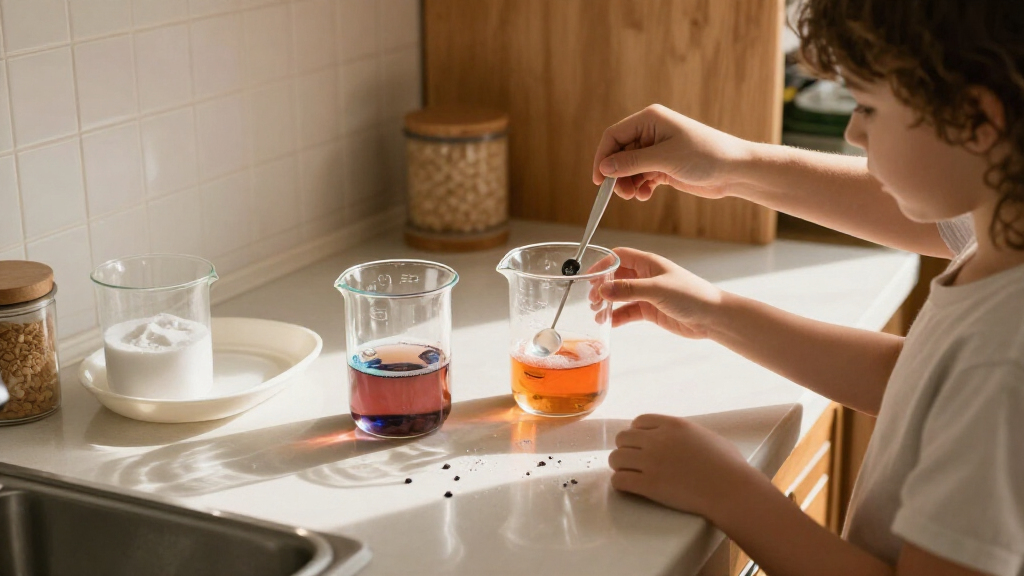
I compared these kits as kitchen science activities for children, rather than treating every general science set as interchangeable. The main criteria were the connection between each activity and food or kitchen concepts, age fit, clarity of the kit’s focus, variety of projects, and how readily a family can picture using it at home. I also considered whether the kit emphasizes making an edible result, exploring a food-related effect, or sampling several kinds of experiments.
The ranking favors useful variety and a clear kitchen-science purpose over a large experiment count by itself. The KiwiCo bundle leads because its ice cream and mini-cake themes offer two different cooking outcomes; Playz follows for families who value a larger activity selection. The younger-age KiwiCo ice cream kit ranks highly for ease of choosing a first project, while the 4M and MindWare options fill narrower interests. Product information does not establish that every activity uses only included materials or works without adult help, so buyers should check package details and plan for kitchen supervision.
| kitchen science experiment kit | Included components |
|---|---|
| KiwiCo Science of Cooking Bund | — |
| 4M Steam Powered Kids Kitchen | — |
| 4M Kitchen Science Kit | Science kit and experiment instructions |
| MindWare Kitchen Science Acade | Bubble Barista unit with bubble lid, pitcher, and base; measuring spoons; measuring cup; jar; two cups; two straws; recipe book |
| Playz Edible Candy Making Scie | — |
| KiwiCo Science of Cooking Ice | Scoop, whisk, large and small cans, clear jar, towel, measuring cups, lab notebook, and ice cream recipes |
Factors to Consider When Choosing Kitchen Science Experiment Kits
The best choice depends on what you want the kitchen activity to accomplish: introduce a young child to cause and effect, make a treat together, or keep an older child busy with a wider set of experiments. I would compare the kits by the kind of experience they support, not just by the number printed on the box.
Match the kit to your child’s kind of curiosity
Some children want a finished snack; others are more interested in watching bubbles form or seeing how ingredients change. A food-making kit can hold attention through a concrete result, while a themed experiment kit may appeal more to a child who enjoys observing and asking why. Ask whether your child prefers following a recipe-like sequence or trying several short activities. A common mistake is choosing the kit that sounds most educational to an adult rather than the one that fits the child’s play style. For shared family activities, pick a theme that gives the child a meaningful role instead of leaving most of the work to an adult.
Check age guidance against the actual work
Age labels are a starting point, not a promise that a child can complete every step independently. Kitchen activities can involve measuring, waiting, handling utensils, or working near warm surfaces, so a younger child may need an adult to manage setup even when the science idea is accessible. Older children may prefer a kit with enough steps to feel like a project rather than a quick demonstration. Before buying, check the listed age range and read the activity descriptions for the kinds of tasks involved. If siblings will share one kit, choose for the youngest child’s safety and let older children take on more of the explanation or recording.
Separate edible projects from food-themed experiments
A kitchen theme does not always mean every result is intended to be eaten. Some kits focus on food preparation, while others use kitchen materials to demonstrate a scientific effect. If eating the result is part of the appeal, verify which activities produce food and whether the instructions address ingredients and preparation. Families managing allergies or dietary restrictions should inspect the materials list before purchase and avoid assuming substitutions will work the same way. This distinction can prevent disappointment when a child expects every experiment to end with a snack.
Look beyond experiment counts
A large activity count can provide variety, but it does not tell you how long each activity lasts, how distinct the experiments are, or how many can be repeated. A smaller set of well-differentiated projects may be a better fit for a child who likes to complete and revisit activities. Check whether the product describes reusable tools, consumable ingredients, or materials a household must supply. Missing or depleted ingredients can limit repeat play even when the core tools remain usable. When comparing kits, weigh the quality and range of the activities against the number alone.
Plan for adult supervision and kitchen cleanup
Kitchen science often uses ordinary household spaces, which makes it convenient but can also create spills, sticky surfaces, or extra preparation. Decide ahead of time whether you are comfortable supervising the whole activity or only helping with setup and cleanup. A child who wants to work independently may need a kit with simple steps and low-risk materials, while a family activity can support more involved adult participation. Set out a washable work area and gather any household supplies before beginning. That small routine helps the experiment stay focused on learning rather than searching for tools midway through.
Pay for a better fit, not a bigger box
It can make sense to choose a more involved kit when it offers distinct projects that suit a child’s interests and age. A focused ice cream activity may be a better first purchase than a broader set if that is the result your child is excited to make. Conversely, a child who tires quickly of one theme may benefit from more varied experiments. Compare the intended use, included components, and need for extra supplies before deciding what represents good value for your household. The strongest choice is the one your child is likely to finish and want to discuss or repeat.
Frequently Asked Questions
Which kit makes the most sense for a child who has never tried kitchen science?
I would start by matching the child’s age and interest to a simple, recognizable activity rather than choosing the kit with the most experiments. The KiwiCo Ice Cream STEM Kit is the most focused option in this lineup for a younger beginner, while the Science of Cooking Bundle adds a second project for a child ready for more variety. An adult should still review the instructions and handle any steps that call for kitchen tools or close supervision. If the child is unsure about food experiments, a narrow theme can be a gentler introduction than a large assortment.
Is the Playz kit a better choice just because it lists more than 40 experiments?
Not automatically: a larger activity count is useful only if the experiments fit your child’s interests and the family can supply any materials they require. Playz is a strong match for children who enjoy moving between many candy-making activities, but a smaller kit may suit a child who wants a clear project and a finished result. Check the activity descriptions for variety, preparation, and whether results are intended to be edible. I would treat the count as a sign of potential breadth, not a guarantee of longer-lasting play.
Should I choose a kit that makes food or one that explores kitchen science?
Choose a food-making kit when the finished treat is a major part of the child’s motivation and you are comfortable with preparation and cleanup. A broader kitchen-science kit may be a better fit when the child enjoys observing changes and trying different kinds of activities, even if not every result is a snack. The KiwiCo cooking options emphasize specific food projects, while the MindWare Bubble Barista kit has a more focused drink-and-bubble theme. Check ingredient details and activity descriptions before buying, especially if allergies or dietary rules affect what your family can use.
Can these kits keep siblings of different ages involved?
They can, but the younger child may need an adult to manage setup and any steps involving utensils or heat, while an older sibling can read directions or explain what is happening. A kit with multiple project types may give siblings more ways to participate than a single-theme activity, though individual interest matters more than age spread alone. Review age guidance for the youngest participant and decide which steps an adult will handle before starting. If the siblings have very different skills, splitting the work into roles can make a shared activity more enjoyable than asking both children to do identical tasks.
What should I check before buying if my child has food allergies?
Read the product’s current packaging and materials information for ingredients, included substances, and any stated allergy warnings. Also check whether the experiments call for household ingredients that are not supplied, since those may introduce additional allergens. Do not assume a substitution will behave the same way in a food-science activity; ask the manufacturer or choose a project that does not rely on the ingredient in question. Keep tools and preparation surfaces separate from foods your child must avoid, and supervise closely throughout the activity.
Conclusion
For most families, I would choose the KiwiCo Science of Cooking Bundle as the best overall because it pairs two different food projects and offers more range than the single-topic ice cream kit. The Playz Edible Candy Making Kit is my best value-style pick for activity variety, provided your child enjoys candy experiments and you are prepared to check material needs. For a younger child or a first kitchen-science activity, the KiwiCo Ice Cream STEM Kit is the best beginner choice. I would pick the KiwiCo bundle as the premium-style option for families seeking multiple guided cooking projects, and the MindWare Bubble Barista Kit for a child specifically drawn to bubbly drinks. Choose a 4M kit when its particular activity style or six-experiment format fits your child better than a food-making focus; the best match is the one that suits their interests, age, and your willingness to supervise.