
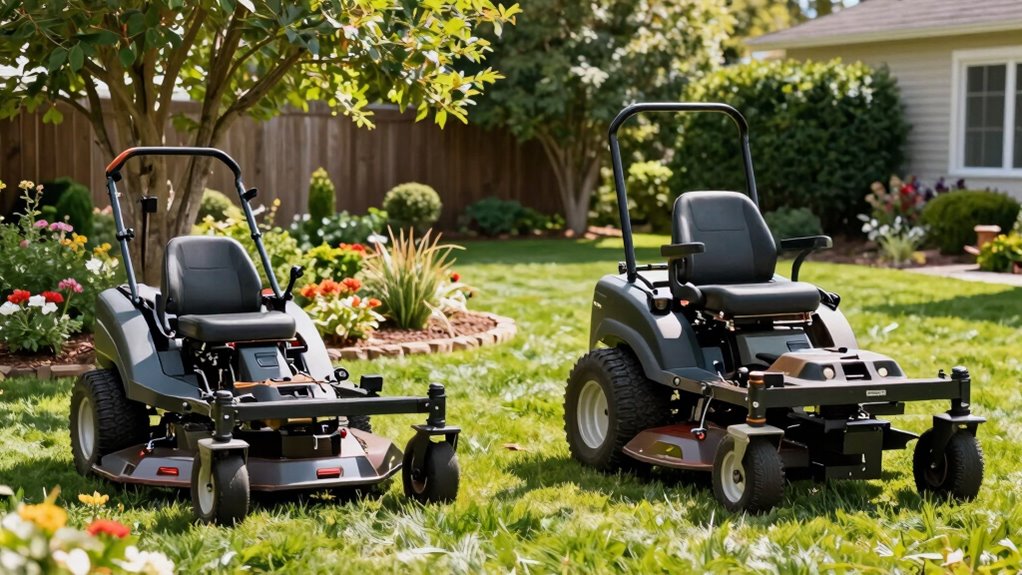

If your yard has lots of obstacles, flower beds, or tight spaces, a zero-turn mower is ideal for precise, quick maneuvering. For large, open areas or uneven terrain, a traditional riding mower offers better stability and a smoother ride. Think about your landscape features, yard size, and terrain needs before choosing. Want detailed tips on which mower fits your specific yard? Keep going to find out more.

Prime made for students and young adults
- Fast, free delivery for dorm and study essentials
- Prime Video and Amazon Music included
- Member-only deals
Key Takeaways
- Zero-turn mowers are ideal for detailed trimming and navigating around obstacles, suitable for landscaped yards with features.
- Traditional riding mowers excel on large, open, flat areas requiring quick coverage and stability on uneven terrain.
- Choose a zero-turn for intricate gardens and tight spaces; opt for a riding mower for extensive, obstacle-free lawns.
- Consider terrain: zero-turns offer agility around landscaping, while riding mowers provide better stability on hills and uneven ground.
- Maintenance complexity and operating ease vary; traditional mowers are simpler, whereas zero-turns may need more upkeep for complex mechanics.

When choosing between a zero-turn mower and a traditional riding mower, understanding their key differences can help you make an informed decision. Your yard’s size, terrain, and the type of work you do all matter. Zero-turn mowers excel at maneuverability, making them ideal for intricate garden trimming and tight spaces. Their quick turns and precise control mean you can easily navigate around flower beds, trees, and other obstacles without damaging plants or spending extra time. If your yard has a lot of landscaping features or hard-to-reach areas, a zero-turn can significantly reduce your mowing time and effort.
On the other hand, traditional riding mowers are often better suited for larger, open spaces. They tend to have a wider cutting deck, which allows you to cover more ground quickly, especially on flat terrain. While they may lack the sharp maneuverability of zero-turns, they often provide a smoother ride and are easier to operate for extended periods. If you’re looking to perform lawn aeration, a traditional mower might be more suitable because it can handle a variety of attachments and is generally more stable on uneven terrain. Additionally, understanding mowing efficiency and how each mower type impacts your overall lawn care routine can help you make a more informed decision.
A yard’s terrain can also influence which mower performs best, especially if your property includes hills or uneven ground, where stability and traction become critical factors. If you spend a lot of time on garden trimming and maintaining a pristine landscape, a zero-turn mower will give you the precision and flexibility you need. Its ability to turn on a dime helps you cut neatly around shrubs and garden beds, preserving your landscape’s aesthetic. For general lawn maintenance over large areas, especially if your yard has few obstacles, a traditional riding mower can save you time and effort with its wider coverage. Moreover, maintenance requirements can vary between the two types, so choosing a mower that fits your willingness to perform regular upkeep is also an important consideration.
Ultimately, your choice hinges on your yard’s size, complexity, and your specific tasks. Zero-turn mowers shine when agility and precision are priorities, especially for detailed garden trimming and targeted lawn aeration. Traditional riding mowers, meanwhile, are better for large, open spaces where speed and stability are more important. By evaluating your yard’s unique features and your mowing needs, you can select the mower that will keep your lawn looking its best with less hassle.
Popular right now

Bose QuietComfort Wireless Noise-Cancelling Headphones, Moonlight Grey

Bose QuietComfort Headphones (2nd Gen), Wireless Noise-Cancelling Over-Ear Headphones, White Smoke

Vitamix 5200 Blender with 64 oz Container, Black
As an affiliate, we earn on qualifying purchases.
Frequently Asked Questions
Which Mower Is Better for Hilly Terrain?
For hilly terrain, a riding mower often outperforms a zero-turn because it offers better terrain navigation and stability. Look for models with a low center of gravity and large rear wheels to prevent tipping. Zero-turn mowers can struggle on steep slopes, and their fuel efficiency may decrease on uneven terrain. So, for safety and efficiency on hills, a traditional riding mower is generally the better choice.
How Much Maintenance Do Zero-Turn Mowers Require?
Zero-turn mowers require regular maintenance, including engine oil changes, blade sharpening, and belt inspections, to keep them running efficiently. They generally have good fuel efficiency, but it depends on usage and engine size. You’ll also notice their noise levels are higher during operation, so using hearing protection is advisable. Regular upkeep guarantees peak performance, extends the mower’s lifespan, and helps you enjoy a smooth, efficient mowing experience.
Are Riding Mowers Suitable for Small Yards?
Riding mowers are suitable for small yards, especially if you prioritize mowing efficiency. They’re easy to operate and can cover your lawn quickly without much effort. Although zero-turn mowers excel in maneuverability, a riding mower offers sufficient performance for small spaces and is often more affordable. If your yard isn’t overly complex, a riding mower provides an efficient, reliable solution that saves you time and effort.
What Is the Average Lifespan of Each Mower Type?
If you own a zero-turn mower, it typically lasts 7-10 years, thanks to its durable construction. For example, a homeowner with proper maintenance might enjoy a 9-year lifespan. Riding mowers last around 10-15 years, but fuel consumption and battery efficiency impact longevity. You can extend lifespan by regularly maintaining the engine, checking the battery, and using the mower appropriately, ensuring both types serve you well over the years.
Can Both Mowers Handle Wet Grass Effectively?
Both mowers struggle with wet grass, especially if the grass is heavily damp or freshly rained on. You’ll find that grass drying is essential for effective mowing, as wet grass can clog blades and reduce cutting efficiency. Zero-turn mowers have sharp, fast blades that can handle some wet grass better, but both types perform best on dry conditions. For best results, wait until the grass dries before mowing.
Conclusion
Choosing between a zero-turn and riding mower is like picking the right brush for your canvas—each stroke shapes your yard’s masterpiece. The zero-turn zips through tight spots with agility, while the riding mower offers steady, broad strokes for larger grounds. Whichever you select, remember it’s about tending your outdoor canvas with care. With the right mower, your yard transforms from a wild patch into a lush, inviting landscape—your personal masterpiece in the making.