

TL;DR
Listen free for 30 days with Audible
Thousands of audiobooks and originals — cancel anytime.
Start your free trialAs an affiliate, we earn on qualifying purchases.
Scientists confirmed the discovery of giant gypsum crystals in Mexico’s Cave of the Crystals. This finding enhances understanding of geological processes and cave formations. Details about the cave’s full extent remain under investigation.
Scientists have confirmed the discovery of massive gypsum crystals in the Cave of the Crystals, located in Naica, Mexico. This marks a significant breakthrough in understanding the cave’s unique geological features, with implications for mineral formation and subterranean ecosystems.
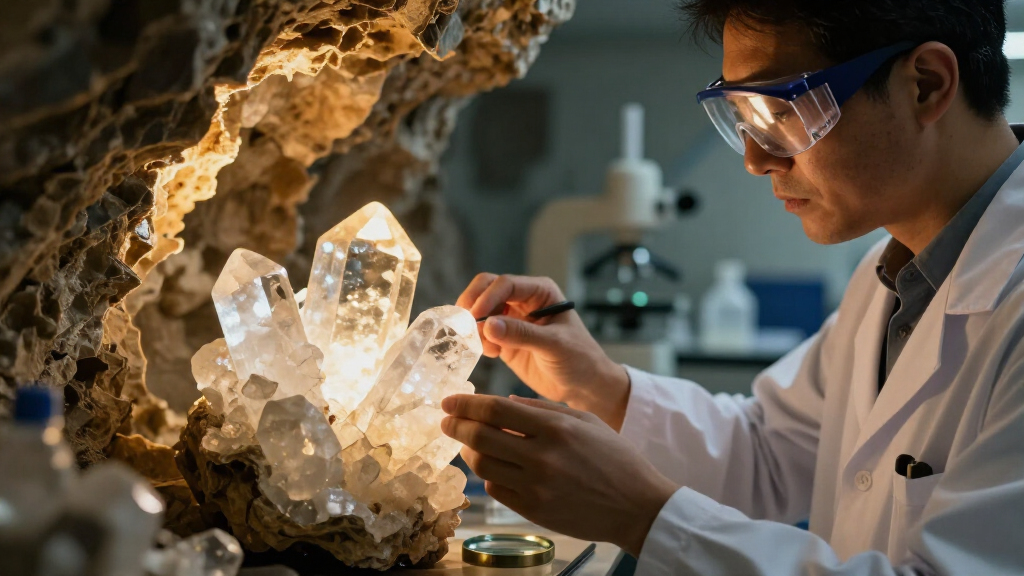
The Cave of the Crystals, known for its extraordinary mineral formations, contains gypsum crystals up to 12 meters long and weighing several tons. Researchers from the National Autonomous University of Mexico (UNAM) confirmed these measurements after recent exploration missions, using remote sensing and sampling techniques.
These crystals formed over hundreds of thousands of years under specific conditions, including high temperatures and mineral-rich waters. The cave’s environment is extremely hostile, with temperatures reaching up to 58°C (136°F) and high humidity, which has historically limited exploration. The recent confirmation involved the use of specialized protective equipment to prevent heat stress and preserve the delicate formations.
While the presence of these crystals was suspected for years, the recent confirmation provides the most detailed data to date, including their size, composition, and the conditions necessary for their growth. Researchers emphasize that this discovery could inform studies of mineral deposits and subterranean geological processes worldwide.
Implications of the Giant Gypsum Crystals Discovery
The confirmed discovery of these massive gypsum crystals in the Cave of the Crystals offers valuable insights into mineral formation under extreme conditions. It could influence future research in geology, mineralogy, and even astrobiology, as scientists explore how similar processes might occur on other planets or moons.
Additionally, this discovery highlights the importance of preserving such fragile natural environments, which are vulnerable to climate change and human activity. Understanding how these crystals formed and the cave’s unique ecosystem may aid in conservation efforts and the development of new exploration technologies.
As an affiliate, we earn on qualifying purchases.
Historical and Scientific Background of the Cave of the Crystals
The Cave of the Crystals, part of the Naica Mine in Chihuahua, Mexico, has been known since the early 2000s for its extraordinary mineral formations. The cave’s environment is characterized by high temperatures and mineral-rich waters, which foster the growth of giant crystals over millennia.
Previous expeditions identified the presence of large gypsum and selenite crystals, but access was limited due to the extreme heat and humidity. In 2019, scientists managed to explore deeper sections using specially designed equipment, leading to the hypothesis that even larger crystals could exist. The recent confirmation validates these hypotheses and provides new data for scientific analysis.
These formations are among the largest mineral crystals ever discovered on Earth, making the Cave of the Crystals a unique natural laboratory for studying mineral growth in extreme environments.
“Accessing these formations required innovative protective gear and careful planning to avoid damaging the fragile environment.”
— Carlos Ramirez, cave exploration specialist
Remaining Unknowns About the Cave’s Full Extent and Conditions
While the presence of giant gypsum crystals has been confirmed, many details about the cave’s full extent, its underground water systems, and the precise timeline of crystal growth remain unclear. Researchers are still studying the cave’s environment to understand how these conditions could be replicated or preserved. It is also not yet confirmed whether similar formations exist in other unexplored sections of the cave or in comparable environments worldwide.
Upcoming Research and Exploration Efforts in the Cave of the Crystals
Scientists plan to conduct further explorations using advanced remote sensing and drilling techniques to map the cave’s full structure and assess the extent of crystal formations. There is also interest in studying the cave’s microbial life, which may have played a role in mineral deposition. Conservation measures are being discussed to protect this fragile environment from potential damage due to increased scientific activity or climate impacts. Additional studies are expected to refine understanding of the cave’s formation history and its broader geological significance.
Key Questions
How large are the gypsum crystals in the Cave of the Crystals?
The confirmed gypsum crystals are up to 12 meters long and weigh several tons, making them some of the largest mineral formations on Earth.
Why is the discovery of these crystals important?
It provides new insights into mineral formation under extreme conditions, informs geological and possibly astrobiological research, and highlights the importance of environmental conservation.
What challenges do scientists face exploring the Cave of the Crystals?
The environment’s extreme heat and humidity pose significant risks to explorers and equipment, requiring specialized protective gear and careful planning.
Are there plans to explore other parts of the cave?
Yes, researchers intend to use advanced technology to map the entire cave system and study additional mineral formations and microbial life.
Source: hn
Flea & tick season Picks
flea and tick prevention
As an affiliate, we earn on qualifying purchases.