
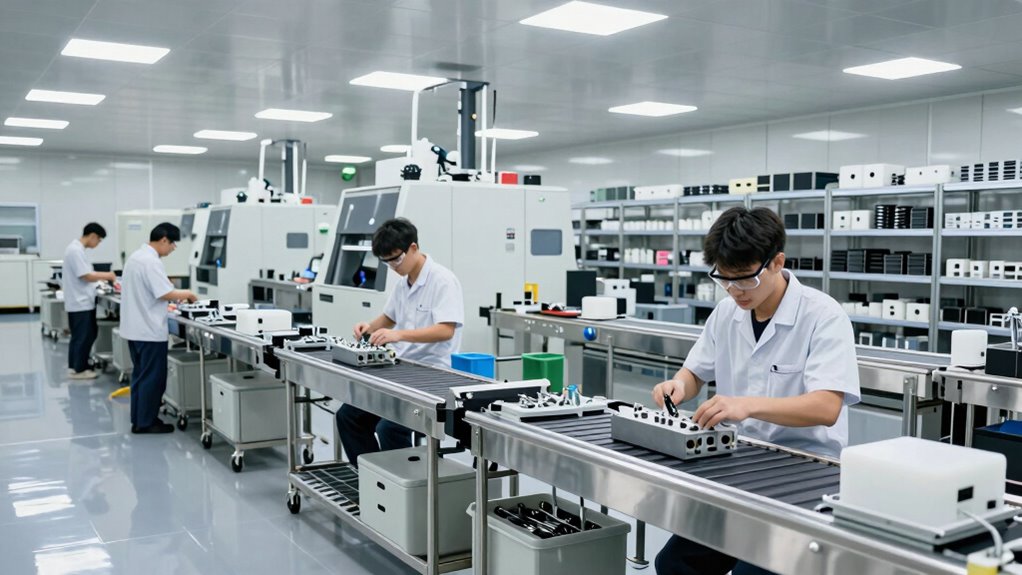

Batch production is a manufacturing method where you produce products in specific quantities through organized steps, balancing flexibility and efficiency. It allows you to switch between different products quickly and customize each batch, making it ideal for industries like baking, pharmaceuticals, or clothing. With proper quality control and resource planning, you can guarantee consistent quality while optimizing equipment and workflow. If you want to understand how these processes work together, there’s more to discover below.

Prime made for students and young adults
- Fast, free delivery for dorm and study essentials
- Prime Video and Amazon Music included
- Member-only deals
Key Takeaways
- Batch production produces specific quantities of products in a single run, allowing flexibility and variation.
- It involves processing groups or batches through various stages before moving to the next.
- This method balances mass production efficiency with customization capabilities.
- It requires strict quality control to ensure consistency across different batches.
- Technology and planning optimize resource use and streamline the manufacturing process.

Have you ever wondered how companies efficiently produce multiple units of the same product? That’s where batch production comes into play. It’s a manufacturing process where a specific quantity of a product is made together in a single run, rather than continuously or one-by-one. This method strikes a balance between mass production and custom manufacturing, offering a practical way to meet diverse demands without the high costs of continuous output. In batch production, each batch is processed through various stages of manufacturing, often with the same equipment, before moving on to the next batch or product. This approach allows companies to produce different products using the same facilities, switching from one batch to another as needed.
One of the key advantages of batch production is the flexibility it provides, especially when it comes to customization options. You can adjust recipes, ingredients, or specifications between batches, tailoring products to specific customer needs or market trends. This flexibility makes batch production ideal for industries like bakery, pharmaceuticals, or clothing, where product variations are common. However, this variability also emphasizes the importance of quality control. Since different batches may involve different materials or processes, maintaining consistent quality across all units becomes critical. Companies implement strict quality control measures at various stages—checking raw materials, inspecting intermediate products, and testing finished goods—to ensure each batch meets standards. Consistent quality control in batch production helps prevent defects, reduces waste, and boosts customer satisfaction.
Batch production offers flexibility for customization while emphasizing the importance of strict quality control measures.
While batch production is efficient for moderate-volume manufacturing, it is also designed to optimize resource use. Equipment can be cleaned, set up, and calibrated between batches to minimize downtime. This setup flexibility enables companies to switch between different products quickly, adapting to changing demands without the need for entirely new manufacturing lines. Additionally, batch production often involves organized workflows, where each stage of manufacturing is carefully planned and monitored. This systematic approach helps streamline operations, control costs, and improve overall productivity. Moreover, understanding the production process involved in batch manufacturing can help businesses better plan their capacity and resource allocation. Proper resource management is essential to maximize efficiency and reduce waste during each batch cycle. Recognizing the importance of production planning can further enhance a company’s ability to meet market demands effectively.
In essence, batch production offers a versatile solution for businesses that need to produce multiple units of a product efficiently, with room for customization and consistent quality. It enables companies to respond swiftly to market needs while maintaining control over the manufacturing process. Whether you’re producing baked goods, pharmaceuticals, or clothing, understanding how batch production operates can help you leverage its benefits to meet your production goals effectively. Additionally, advances in automation technology can further optimize batch processes, reducing manual effort and increasing precision.
As an affiliate, we earn on qualifying purchases.
Frequently Asked Questions
How Does Batch Production Differ From Continuous Production?
You notice that batch production differs from continuous production because it focuses on producing specific quantities of products in distinct groups, allowing for mass customization and flexible scheduling. Unlike continuous production, which runs nonstop to produce large volumes, batch production adapts easily to changing demands. This flexibility helps you tailor products to customer needs while managing production schedules efficiently, making it ideal for smaller runs and diverse product lines.
What Industries Primarily Use Batch Production Methods?
You’ll find industries like food, pharmaceuticals, and cosmetics mainly use batch production methods. This approach suits product customization, allowing companies to produce different items in the same equipment setup. Equipment flexibility is vital here, enabling quick adjustments for various product batches. Batch production helps meet specific customer needs while efficiently managing production runs, making it ideal for industries requiring diverse product lines and customization options.
What Are the Main Advantages of Batch Production?
Ever imagined efficiently managing multiple products? Batch production allows you to do this by enabling flexible production scheduling, reducing lead times, and controlling inventory management. You can switch between different products without extensive retooling, saving costs and increasing responsiveness to market demands. Its main advantages include better quality control, minimized waste, and the ability to meet specific customer needs while balancing production efficiency.
How Is Quality Control Managed in Batch Production?
In batch production, you manage quality control through regular quality inspections at various stages to catch issues early. You also track defects meticulously to identify recurring problems and maintain standards. By implementing consistent inspection routines and keeping detailed defect records, you guarantee each batch meets quality requirements. This proactive approach helps you minimize waste, improve processes, and guarantee that the final products satisfy customer expectations.
What Are Common Challenges Faced in Batch Manufacturing?
You often face challenges with process flexibility and equipment setup in batch manufacturing. Adapting to different product specifications can be time-consuming, reducing efficiency. Additionally, equipment setup requires careful planning, as frequent changes can lead to delays and increased costs. Managing these challenges involves optimizing workflows, investing in versatile machinery, and implementing strict scheduling to facilitate smooth shifts between batches, ultimately maintaining quality and productivity.
Conclusion
Think of batch production as a skilled conductor guiding a symphony, where each group of products plays its own harmonious tune before moving on. It’s a dance of efficiency and precision, balancing flexibility with consistency. Just as a painter carefully layers each stroke, you craft each batch with purpose and care. In this process, you’re weaving a tapestry of productivity, where every stitch counts, creating a masterpiece from the threads of time and effort.
Halloween Picks
halloween
As an affiliate, we earn on qualifying purchases.