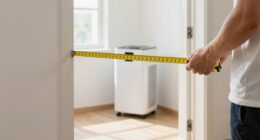
When you see coverage claims on an air purifier, check if they’re based on real-world testing or just theoretical estimates, as manufacturers might inflate numbers. Look for independent reviews and certifications like AHAM to verify the claims. Also, match the coverage with the device’s CADR rating to guarantee it can clean your room size effectively. Proper placement and maintenance matter too. Keep going to discover more tips for making the best choice.

Prime made for students and young adults
- Fast, free delivery for dorm and study essentials
- Prime Video and Amazon Music included
- Member-only deals
Key Takeaways
- Check if coverage claims are based on independent testing or theoretical calculations.
- Match the claimed coverage area with the device’s CADR ratings for accuracy.
- Verify that the filter is a true HEPA for effective particle removal.
- Ensure the coverage aligns with real-world testing and user reviews.
- Consider additional factors like airflow, placement, and room conditions affecting actual performance.
When shopping for an air purifier, understanding the coverage claims on the packaging can seem confusing at first. Manufacturers often list coverage in terms of square footage, but these claims aren’t always straightforward. To get the most effective purifier for your space, you need to decode what these numbers really mean. First, pay attention to the HEPA filtration system. A true HEPA filter captures at least 99.97% of airborne particles as small as 0.3 microns, including dust, pollen, pet dander, and some bacteria. If the product highlights HEPA filtration, it’s a good sign that the purifier can handle the microscopic particles contributing to allergies and respiratory issues. However, HEPA filtration alone doesn’t tell you how quickly or efficiently the purifier cleans the air in a given area. That’s where the CADR, or Clean Air Delivery Rate, ratings come into play.
CADR ratings are standardized measurements that indicate how much clean air an air purifier produces per minute for specific pollutants like dust, pollen, and smoke. Higher CADR numbers mean the device works faster and more effectively in larger spaces. When reading coverage claims, compare the CADR ratings to your room size. For instance, a CADR of 200+ is suitable for rooms up to 300 square feet, while a CADR of 300+ can handle spaces around 500 square feet or more. Many manufacturers list both the CADR and recommended room size on the packaging, which helps you determine if the purifier can handle your space. Keep in mind that these ratings assume the purifier is used correctly and is well-maintained, with clean filters and proper placement. Additionally, understanding filter efficiency and how it impacts overall performance can help you choose the best model for your needs.
Additionally, check whether the coverage claim is based on real-world testing or theoretical calculations. Some brands inflate their claims, so it’s wise to look for independent reviews or certifications from organizations like AHAM (Association of Home Appliance Manufacturers). These often verify CADR ratings and provide an objective basis for comparison. It’s also helpful to consider airflow dynamics, as factors like furniture placement and ceiling height can influence the purifier’s effectiveness. Remember, the size of your room isn’t the only factor—airflow, ceiling height, and even furniture placement can influence how well an air purifier performs. To guarantee you’re making an informed decision, match the coverage claim with the CADR ratings and verify that the device has a true HEPA filter. Doing so helps you select an air purifier that effectively cleans your space and improves indoor air quality.
Popular right now

Ninja SP151 Flip Toaster Oven and Air Fryer, 8-in-1, Stainless Steel

Ninja CREAMi 7-in-1 Ice Cream Maker, NC301

Dreame L50 Ultra Robot Vacuum and Mop
As an affiliate, we earn on qualifying purchases.
Frequently Asked Questions
Do Coverage Claims Account for Real-World Airflow Obstructions?
Coverage claims often don’t fully account for airflow obstructions, so your actual room coverage might be less than advertised. You should consider real-world adjustments like furniture, curtains, or closed doors, which can hinder airflow. To guarantee effective purification, position your air purifier in open spaces and avoid obstructions. This way, you get a more accurate idea of how well it will work in your specific environment.
How Do Room Shape and Furniture Affect Purifier Efficiency?
Room shape and furniture placement considerably impact your air purifier’s efficiency. An irregular room layout or crowded furniture can block airflow, reducing purification performance. You should position your purifier where air circulates freely, ideally away from large furniture pieces or walls. Adjust furniture placement to optimize airflow paths, ensuring the device can effectively clean the entire space. Proper placement maximizes coverage, making your air purifier work more efficiently in your specific room shape.
Are Coverage Claims Adjusted for Multiple Air Pollutants?
Back in the day, air purifiers were simple gadgets, but today’s claims are more sophisticated. Coverage claims often aren’t fully adjusted for multiple pollutant types, which can impact claim accuracy. When evaluating, consider whether the device targets various pollutants like dust, pollen, and VOCs. A more thorough claim indicates the purifier can handle multiple pollutants simultaneously, giving you a clearer idea of its true coverage for your specific air quality needs.
How Often Should I Run the Purifier for Optimal Coverage?
You should run your air purifier continuously for ideal coverage, especially if you want to maximize filter lifespan and maintain consistent air quality. If noise levels bother you, consider setting it on a lower fan speed during the night. Regularly check the filter and replace it as recommended, which helps keep the purifier running efficiently. This approach guarantees thorough coverage and helps prolong your device’s lifespan.
Do Coverage Claims Include Maintenance or Filter Replacement?
Coverage claims typically don’t include maintenance or filter replacement, so you should consider your purifier’s filter lifespan and maintenance frequency separately. Manufacturers often recommend changing filters every few months, depending on use and air quality. Keep in mind that neglecting filter replacement can reduce efficiency and coverage. Regular maintenance ensures your purifier works at its best, maintaining the claimed coverage area and improving indoor air quality over time.
Conclusion
Now that you know how to decode those coverage claims, you’re practically armed with a superpower to banish airborne villains. Imagine your air purifier as a mighty fortress, shielding your entire home from invisible threats. With this knowledge, you can confidently choose the perfect model, creating a bubble of pure, fresh air so powerful it could make clouds jealous. Step into your air-cleaning destiny and breathe easier—your home’s air quality just got a whole lot smarter!