
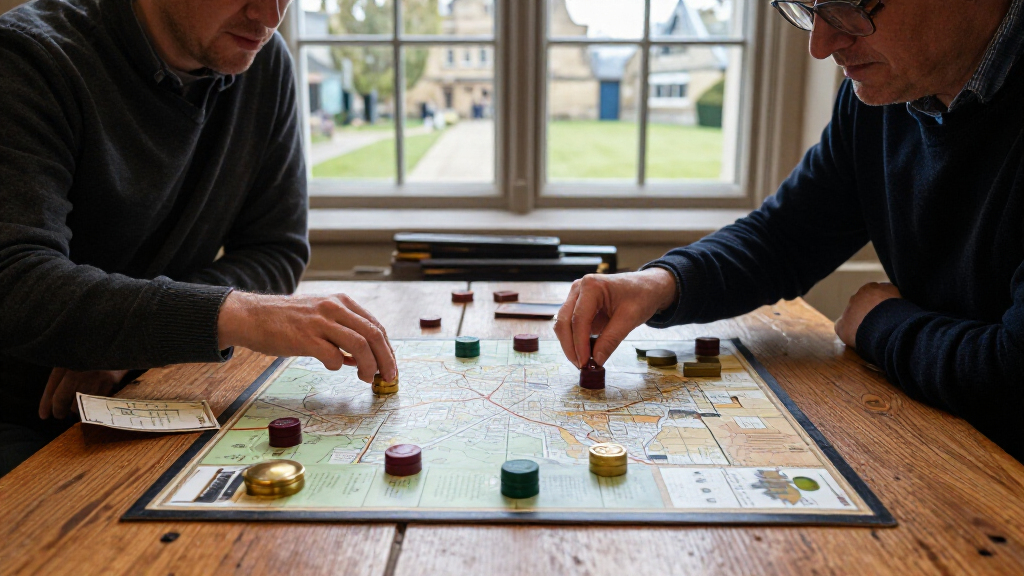

The best historical mystery board games pair a period setting with deductions that give players meaningful choices. I rank Whitehall Mystery as the best overall for its tense hidden-movement hunt in Victorian London; Kronologic: Paris 1920 stands out for compact logic puzzles, while Chronicles of Crime: 1400 suits players who want a story-rich medieval case. The main tradeoffs are app use versus screen-free play, open-ended investigation versus focused deduction, and one-time cases versus repeatable challenges. Read on for how all seven differ and which style best fits your group.

Prime made for students and young adults
- Fast, free delivery for dorm and study essentials
- Prime Video and Amazon Music included
- Member-only deals
Key Takeaways
- Whitehall Mystery leads for a period setting built into the central chase, rather than added as decoration.
- Kronologic: Paris 1920 favors concise, structured deduction, while Chronicles of Crime leans on app-supported investigation and evidence gathering.
- Clue: Treachery at Tudor Mansion is the most approachable entry point, but its guided, escape-room structure is different from an open-ended whodunit.
- Scotland Yard – Sherlock Holmes Edition and Whitehall both use pursuit, but the former offers a more familiar, accessible chase framework.
- Chronicles of Crime: 1400 and Murder at Maple Manor prioritize narrative case-solving; buyers should check their appetite for app-led or scenario-based play before choosing.
| Clue: Treachery at Tudor Mansion |  | Best for Family Groups | Brand: Hasbro Gaming | Players: 1–6 | Minimum age: 10+ | VIEW LATEST PRICE | See Our Full Breakdown |
| Chronicles of Crime |  | Best for App-Assisted Investigation | Brand: Lucky Duck Games | Players: 1–4 | Age range: 12+ | VIEW LATEST PRICE | See Our Full Breakdown |
| Whitehall Mystery Board Game |  | Best for Tactical Victorian Deduction | Brand: Giochi Uniti | Players: 2–4 | Minimum age: 13+ | VIEW LATEST PRICE | See Our Full Breakdown |
| Ravensburger Scotland Yard – Sherlock Holmes Edition |  | Best for Easy-to-Teach Group Pursuit | Brand: Ravensburger | Players: 2–6 | Minimum age: 8+ | VIEW LATEST PRICE | See Our Full Breakdown |
| Kronologic: Paris 1920 – Murder Mystery Game for Teens & Adults, 1–4 Players, 30 min |  | Best for Short, Replayable Historical Mysteries | Brand: Scorpion Masqué | Players: 1–4 | Minimum age: 10+ | VIEW LATEST PRICE | See Our Full Breakdown |
| Lucky Duck Games Chronicles of Crime: 1400 |  | Best for Historical, App-Assisted Investigations | Brand: Lucky Duck Games | Players: 1–4 | Recommended age: 12 years and up | VIEW LATEST PRICE | See Our Full Breakdown |
| Murder at Maple Manor Murder Mystery Game |  | Best for Long, Document-Led Historical Cases | Brand: Trench & Trilby | Genre: Mystery | Players: 1 or more; suitable for groups of up to 12 | VIEW LATEST PRICE | See Our Full Breakdown |
| historical mystery board game | Brand | Players | Included components | Minimum age |
|---|---|---|---|---|
| Clue: Treachery at Tudor Mansi | Hasbro Gaming | 1–6 | — | 10+ |
| Chronicles of Crime | Lucky Duck Games | 1–4 | Evidence Board, 55 Character Cards, 52 Evidence Category and Special Item Cards, Rulebook, 17 Location Boards, 4 Forensic Contact Boards | — |
| Whitehall Mystery Board Game | Giochi Uniti | 2–4 | — | 13+ |
| Ravensburger Scotland Yard | Ravensburger | 2–6 | Game Board, 6 Game Pieces, 29 Starting Cards, 130 Tickets, 3 Double Turn Tickets, 6 Character Boards, Journey Board, Screen, 2 Rings for Detectives | 8+ |
| Kronologic: Paris 1920 | Scorpion Masqué | 1–4 | Game board, 6 Character placards, 6 Time placards, note-sheet pad, 4 Screens, 3 Scenarios (15 investigations), 90 Cards, 4 Pencils, Rulebook | 10+ |
| Lucky Duck Games Chronicles of | Lucky Duck Games | 1–4 | Dog Companion Card, Home Location Board, Rulebook, Thematic Card Evidence Board, 15 Special Item Cards, 20 Oversized Vision Cards, 30 Character Cards, 35 Evidence Category Cards, and 7 double-sided Location Boards | — |
| Murder at Maple Manor Murder M | Trench & Trilby | 1 or more; suitable for groups of up to 12 | Case files with letters, reports, receipts, statements, and photos | — |
More Details on Our Top Picks
Clue: Treachery at Tudor Mansion
Tudor-era setting and familiar deduction make this the most approachable pick here for a family that wants a historical backdrop without a heavy rules load. It supports up to six players, matching the group-friendly scale of Scotland Yard – Sherlock Holmes Edition, but its Clue-style whodunit framing is a closer fit for players who want to discuss suspects and solve a contained mystery. Compared with the more tactical Whitehall Mystery, it is positioned for casual family and party play rather than a tense pursuit built around hidden movement. The tradeoff is that the supplied details do not specify scenario variety or a playtime, so buyers seeking clearly described replay options may prefer Kronologic: Paris 1920. It is English-only, which limits its usefulness for multilingual households.
Pros:- Tudor setting gives family-friendly deduction a historical frame
- Supports groups of up to six players
- Mystery and deduction theme suits family or party sessions
- Includes the components needed to play in one package
Cons:- Available only in English
- Provided product details do not state playtime or the number of scenarios
- Less clearly suited to strategic pursuit play than Whitehall Mystery
Best for: Families and casual groups of up to six who want a Tudor-themed whodunit with familiar deduction conventions.
Not ideal for: Multilingual households or strategy-focused players seeking detailed asymmetric rules, a documented short playtime, or clearly specified replay scenarios.
- Brand:Hasbro Gaming
- Players:1–6
- Minimum age:10+
- Genre:Party/Family
- Material:Cardboard
- Dimensions:7.87 × 1.61 × 10.51 in
- Weight:1.2 lb
- Model number:F5699
Our verdict“Choose Clue: Treachery at Tudor Mansion for an English-speaking family group that values accessible Tudor-themed deduction over documented scenario depth.”
Chronicles of Crime
Digital crime-scene investigation sets Chronicles of Crime apart from the lineup: players use a free smartphone app alongside tabletop cards and boards to question suspects and gather evidence cooperatively. That structure makes it a stronger choice than Clue: Treachery at Tudor Mansion for a group that wants to work through investigative steps together, though the supplied description does not specify a historical setting, so its fit for a history-first mystery roundup is less direct. At about 90 minutes, it also asks for a longer session than Kronologic: Paris 1920, which lists a 30-minute playtime. Multiple scenarios give it a reason to return to the table, but first-time setup can take time and a compatible smartphone is required. Skip it if your group wants a fully analog historical mystery.
Pros:- Cooperative play gives players shared investigative decisions
- Free smartphone app adds digital crime-scene investigation
- Multiple scenarios provide replay options
- Listed 90-minute session length supports a substantial investigation
Cons:- Requires a compatible smartphone to use the app
- First-time setup can take time
- Product details do not identify a historical setting
Best for: Cooperative mystery groups of one to four who are comfortable using a smartphone and want app-guided investigation with multiple scenarios.
Not ideal for: Players seeking a clearly historical setting, an app-free game, or a short session closer to Kronologic: Paris 1920’s listed 30 minutes.
- Brand:Lucky Duck Games
- Players:1–4
- Age range:12+
- Playing time:90 minutes
- Edition:Standard Edition
- Included components:Evidence Board, 55 Character Cards, 52 Evidence Category and Special Item Cards, Rulebook, 17 Location Boards, 4 Forensic Contact Boards
- Dimensions:11.81 × 2.05 × 11.81 in
Our verdict“Pick Chronicles of Crime if app-assisted teamwork matters more to your group than a clearly defined historical era or a short playtime.”
Whitehall Mystery Board Game
Victorian London and asymmetric pursuit give Whitehall Mystery the clearest historical atmosphere among these picks. One player secretly takes Jack’s role while the others investigate and try to capture him, creating a cat-and-mouse contest that feels more tactical than Clue: Treachery at Tudor Mansion’s family-oriented whodunit. Its three phases and optional rules add strategic variation, while the roughly 60-minute session is shorter than Chronicles of Crime’s listed 90 minutes. The tradeoff is accessibility: the rules may challenge newcomers, and the stated player range is only two to four, so it cannot cover as large a gathering as Scotland Yard – Sherlock Holmes Edition. I’d choose it for a small group that welcomes bluffing and hidden movement, not for an easygoing first mystery game.
Pros:- Victorian London setting gives the mystery a distinct historical identity
- Asymmetric Jack-versus-investigators roles create bluffing and deduction
- Three phases and optional rules add session variety
- Listed playtime is about 60 minutes
Cons:- Rules may be challenging for players new to tactical games
- Supports only two to four players
- One player takes the opposing hidden-role position rather than joining the investigators
Best for: Two-to-four-player groups who enjoy tactical deduction, hidden roles, and a strong Victorian London setting.
Not ideal for: New players wanting simple rules, larger groups, or a more cooperative investigation without a secret opposing player.
- Brand:Giochi Uniti
- Players:2–4
- Minimum age:13+
- Playing time:60 minutes
- Genre:Tactical
- Language:English
- Manufacturer:ASMODEE
- Model number:BI13154
Our verdict“Choose Whitehall Mystery for a small, experienced group that wants Victorian atmosphere and tactical hidden-role pursuit.”
Ravensburger Scotland Yard – Sherlock Holmes Edition
Accessible London pursuit is the reason to choose this edition: players race to catch Professor Moriarty, with Sherlock Holmes framing the chase in a familiar historical setting. It plays two to six and lists a 45-minute session, giving it broader group reach and a shorter stated playtime than Whitehall Mystery, which is more tactical but limited to four players. The clear rules and age range of eight-plus also make this a more approachable family option than Chronicles of Crime, whose app and longer session add extra demands. The tradeoff is that the central experience is a pursuit across London, not a case built around interviewing suspects and piecing together a historical crime. Setup uses a sizeable set of tickets and boards, so it may take longer to get to the chase than a compact card-led game.
Pros:- Supports groups of two to six
- Listed 45-minute playtime suits shorter game sessions
- Age range of eight-plus and clear rules support family play
- London chase gives the Sherlock Holmes theme a direct gameplay role
Cons:- Focuses on pursuit rather than detailed case investigation
- Numerous tickets, boards, and other components can make setup take time
- Larger groups may have to wait for turns during the chase
Best for: Families and mixed-age groups of two to six who want an easy-to-teach Sherlock Holmes-themed pursuit game.
Not ideal for: Players who want detailed crime-scene investigation, a historically specific case, or minimal setup components.
- Brand:Ravensburger
- Players:2–6
- Minimum age:8+
- Estimated playing time:45 minutes
- Model number:27344
- Included components:Game Board, 6 Game Pieces, 29 Starting Cards, 130 Tickets, 3 Double Turn Tickets, 6 Character Boards, Journey Board, Screen, 2 Rings for Detectives
Our verdict“Choose this edition for a family-sized group that prefers a straightforward Sherlock Holmes chase to a detailed historical investigation.”
Kronologic: Paris 1920 – Murder Mystery Game for Teens & Adults, 1–4 Players, 30 min
Paris in 1920, 15 investigations, and 30-minute sessions make Kronologic the clearest fit for players who want a compact historical mystery they can revisit. Solo, cooperative, and competitive modes let the same group choose how to approach deduction, unlike Whitehall Mystery, which centers on an investigator team facing one hidden opponent. Its listed session is also much shorter than Chronicles of Crime, making it easier to fit into a short game night. The three scenarios and investigation count offer structure, but the cards, placards, screens, and note sheets mean setup is not as minimal as the short runtime might suggest. Its puzzle-focused deductions may also be less welcoming to younger or casual players than Scotland Yard – Sherlock Holmes Edition, which lists an age range starting at eight.
Pros:- Paris 1920 setting gives the mystery a defined historical era
- Solo, cooperative, and competitive modes suit different group preferences
- Three scenarios contain 15 investigations
- Listed 30-minute sessions suit shorter play windows
Cons:- Cards, placards, screens, and note sheets can make setup involved
- Puzzle-focused deduction may challenge casual players
- Supports no more than four players
Best for: Mystery fans, including solo players, who want short deduction sessions set in 1920s Paris and value several play modes.
Not ideal for: Younger or casual players seeking the easiest rules, or groups that want a simple setup and a sprawling narrative investigation.
- Brand:Scorpion Masqué
- Players:1–4
- Minimum age:10+
- Playing time:30 minutes
- Genre:Mystery, Puzzle, Strategy
- Included components:Game board, 6 Character placards, 6 Time placards, note-sheet pad, 4 Screens, 3 Scenarios (15 investigations), 90 Cards, 4 Pencils, Rulebook
- Dimensions:8.97 × 6.24 × 0.1 in
- Edition:Standard Edition
Our verdict“Pick Kronologic: Paris 1920 for a solo or small-group player seeking replayable historical deductions in short sessions.”
Lucky Duck Games Chronicles of Crime: 1400
Chronicles of Crime: 1400 is the strongest fit here for players who want a historical setting woven into the investigation itself. You play Abelard Lavel, a knight in 15th-century Paris, combining witness interviews and evidence with prophetic vision cards to work through cases as a group. The Scan & Play app handles digital storytelling, so this feels more like an unfolding investigation than a paper case file such as Murder at Maple Manor. Its one-to-four-player range also suits a couple or small group, while the multiple cases give it more replay potential than a single long-form mystery. The tradeoff is that a smartphone is required, and the app-led format may not suit players seeking an entirely screen-free game. At 60–90 minutes per session, it is also a more contained commitment than Maple Manor’s estimated four hours.
Pros:- 15th-century Paris setting gives the mystery a distinct historical frame.
- Cooperative play supports solo games as well as groups of up to four.
- App-based storytelling combines with physical evidence and vision cards.
- Multiple cases offer more replay opportunities than a single-case experience.
Cons:- A smartphone and app are required to access the storytelling.
- The player limit may exclude larger groups.
- The recommended age of 12 and up may make it less suitable for younger children.
Best for: Small groups or solo players who want cooperative investigations set in medieval Paris, with digital story delivery and multiple cases.
Not ideal for: Players who prefer screen-free mysteries or want a large-group, document-based case that can occupy a longer evening.
- Brand:Lucky Duck Games
- Players:1–4
- Recommended age:12 years and up
- Playing time:60–90 minutes
- Language:English
- Edition:Standard Edition
- Included components:Dog Companion Card, Home Location Board, Rulebook, Thematic Card Evidence Board, 15 Special Item Cards, 20 Oversized Vision Cards, 30 Character Cards, 35 Evidence Category Cards, and 7 double-sided Location Boards
Our verdict“Choose Chronicles of Crime: 1400 for a compact, cooperative medieval mystery with app-driven storytelling, but skip it if your group wants a screen-free case file.”
Murder at Maple Manor Murder Mystery Game
Murder at Maple Manor suits players who want to sort through a substantial case file rather than follow a brisk board-game investigation. Its Gilded Age poisoning mystery is presented through more than 30 physical evidence pieces, including letters, reports, receipts, statements, and photos, with online clues adding another layer. That paper-trail approach gives it a different feel from Chronicles of Crime: 1400, where an app guides a shorter, cooperative investigation in medieval Paris. Maple Manor can accommodate solo play or a group of up to 12, making it the better choice for a mystery night with a larger gathering. The tradeoff is time: its estimated four-hour session asks for a dedicated evening, and the digital evidence means it is not fully offline despite its document-heavy format.
Pros:- More than 30 physical evidence pieces create a document-focused investigation.
- Online clues add evidence beyond the printed case materials.
- Works for solo play and groups of up to 12.
- Gilded Age manor setting gives the poisoning case a period backdrop.
Cons:- The estimated four-hour play time requires a substantial time commitment.
- Online evidence means players need internet access during the case.
- The recommended minimum age of 14 limits suitability for younger players.
Best for: Players planning a long mystery night who enjoy examining physical documents, connecting clues, and involving a large group or playing solo.
Not ideal for: Groups seeking a short, repeatable board-game session or a fully offline mystery that avoids online evidence.
- Brand:Trench & Trilby
- Genre:Mystery
- Players:1 or more; suitable for groups of up to 12
- Language:English
- Estimated playing time:4 hours
- Included components:Case files with letters, reports, receipts, statements, and photos
- Minimum recommended age:14 years
- Material and dimensions:Paper; 12 x 9 x 0.1 inches
- Usage:Indoor
Our verdict“Pick Murder at Maple Manor for a long, evidence-heavy Gilded Age case with room for a crowd, not for a quick or fully offline game.”

How We Picked
I compared the seven games by how closely their historical setting shapes play, how satisfying their deduction systems are, and how readily a group can learn and run a session. I also weighed player interaction, session length where stated, reliance on a companion app, replay potential, and whether the game works better for newcomers, experienced mystery fans, or a specific group size. Historical atmosphere alone was not enough to rank a game highly: the period needs to support the mystery or give the investigation a distinct feel.
Whitehall Mystery takes the lead because its Victorian setting and hidden-movement pursuit reinforce each other, while Kronologic: Paris 1920 earns a distinct place for direct, focused logic play. Story-forward options rank well for players who want to interpret evidence, but app dependence and case structure narrow their fit. More familiar or guided choices sit lower not because they lack appeal, but because they offer less of the open-ended historical deduction that defines this roundup.
| historical mystery board game | Brand | Genre | Included components |
|---|---|---|---|
| Clue: Treachery at Tudor Mansi | Hasbro Gaming | Party/Family | — |
| Chronicles of Crime | Lucky Duck Games | — | Evidence Board, 55 Character Cards, 52 Evidence Category and Special Item Cards, Rulebook, 17 Location Boards, 4 Forensic Contact Boards |
| Whitehall Mystery Board Game | Giochi Uniti | Tactical | — |
| Ravensburger Scotland Yard | Ravensburger | — | Game Board, 6 Game Pieces, 29 Starting Cards, 130 Tickets, 3 Double Turn Tickets, 6 Character Boards, Journey Board, Screen, 2 Rings for Detectives |
| Kronologic: Paris 1920 | Scorpion Masqué | Mystery, Puzzle, Strategy | Game board, 6 Character placards, 6 Time placards, note-sheet pad, 4 Screens, 3 Scenarios (15 investigations), 90 Cards, 4 Pencils, Rulebook |
| Lucky Duck Games Chronicles of | Lucky Duck Games | — | Dog Companion Card, Home Location Board, Rulebook, Thematic Card Evidence Board, 15 Special Item Cards, 20 Oversized Vision Cards, 30 Character Cards, 35 Evidence Category Cards, and 7 double-sided Location Boards |
| Murder at Maple Manor Murder M | Trench & Trilby | Mystery | Case files with letters, reports, receipts, statements, and photos |
Factors to Consider When Choosing Historical Mystery Board Games
Before choosing, decide what kind of mystery your group wants to solve. Historical games can mean anything from a period chase to a narrative investigation, and those formats ask for different levels of patience, conversation, and rule learning.
Choose the mystery format before the setting
A Victorian street hunt, a medieval evidence case, and a Tudor escape-room story may all qualify as historical mysteries, but they create very different evenings. Hidden-movement games reward tracking and reading an opponent; logic puzzles reward orderly note-taking; narrative cases invite discussion and interpretation. A common mistake is choosing by era or theme alone, then finding the core activity does not suit the group. Ask whether players want to compete, collaborate, or solve clues side by side before choosing a period. If your group enjoys several styles, favor a game whose central rules are easy to explain so the setting can carry the variety.
Check how much screen use the group accepts
App-supported investigations can organize clues, present story details, or add tools that a printed case cannot provide. That convenience comes with practical dependencies: a charged device, compatible software, and a willingness to share screen time at the table. Screen-free play can feel more tactile and keeps discussion centered on shared components, though it may ask players to manage more information themselves. Before buying, check whether the app is required for play or only adds optional features, and whether one device can serve the whole group. Avoid assuming that a historically themed box will provide a fully offline experience.
Match the rules and session shape to your players
New players often benefit from a guided scenario or familiar deduction structure, while regular hobby gamers may prefer a system that rewards careful planning over several rounds. A stated 30-minute session, such as Kronologic: Paris 1920, can suit a short game night, but setup, teaching, and discussion may extend the visit at the table. Case-based games can take longer when the group debates every clue, even if the rules are simple. For mixed-experience groups, look for clear turn structure and shared information rather than assuming a low player count means low complexity. If younger players are joining, check the publisher’s age guidance and the reading load as well as the theme.
Think about replay value and case permanence
Some mystery games are built around reusable deduction, while others make the first solution the main event. A solved case may have limited surprise on a second play, so replay value depends on whether the game changes roles, information, or the puzzle itself. That can still be a good fit for a group that likes a planned one-night experience, but it matters if you want a regular game-night staple. Check the scenario count and whether the game supports reset or alternate cases before treating a single box as a long-term library anchor. For repeated play, systems with changing information or competitive hidden movement often have a different advantage from fixed narratives.
Pay for the experience your group will actually use
A more involved narrative or app-supported system may be worthwhile when your group likes immersive cases and will make time to discuss evidence. A simpler, guided game can be the better buy for occasional guests who need a quick explanation and a clear finish. Components and historical detail matter most when they reinforce the investigation, not when they merely add atmosphere. Compare the amount of setup, reading, and table coordination with how often your group meets. If you are uncertain, prioritize flexibility and an easy first session over a larger box or more elaborate presentation.
Frequently Asked Questions
Which game is the best starting point for people new to deduction games?
Clue: Treachery at Tudor Mansion is the clearest starting point here for groups who want a guided introduction, while Scotland Yard – Sherlock Holmes Edition offers a familiar pursuit structure. The better choice depends on whether your group prefers solving a sequence of scenarios or tracking a hidden opponent. Neither format is identical to a free-form investigation, so experienced mystery fans may want more open deduction. Keep the first session short and let one player explain the core turn before adding strategy. That approach helps newcomers focus on clues rather than rule details.
Which picks work best for a group that wants an offline game night?
Start by checking each game’s current edition and component requirements, since app features can vary by product or update. Whitehall Mystery, Scotland Yard – Sherlock Holmes Edition, and Kronologic: Paris 1920 are stronger candidates if your group wants the central play to stay around the board. App-led Chronicles of Crime titles are less suitable if screens are unwelcome or internet access is uncertain. A device used only for rules or setup still changes the table experience, so clarify your group’s preference first. When in doubt, choose a game whose main deduction loop is fully represented by physical components.
Do these games have replay value after the mystery is solved?
Replay depends on the format more than the historical theme. Hidden-movement and changing-information systems can offer fresh decisions across sessions, while a fixed narrative case may lose some surprise once players know the solution. Scenario variety can extend a game’s life, but it does not always make a solved case feel new. If your group mainly wants a single shared event, a one-and-done structure can still be satisfying. For a recurring game-night choice, look for variable roles, multiple cases, or puzzles that change with play.
Which game should I choose for a short session?
Kronologic: Paris 1920 is listed as a 30-minute game, making it the clearest fit for a compact session among these options. Allow extra time for teaching and for players to discuss their deductions, especially on a first play. Narrative investigations may stretch when a group wants to examine every clue, while chase games can vary with player pace. If the group has a firm time limit, set expectations before play and pick a format with simple turns. A short printed duration is a useful guide, not a guarantee that the whole visit will fit that window.
How should I choose between Whitehall Mystery and Scotland Yard – Sherlock Holmes Edition?
Choose Whitehall Mystery if you want a tense hidden-movement pursuit with a stronger Victorian-London identity and a more focused feel. Pick Scotland Yard – Sherlock Holmes Edition if a familiar chase framework and an approachable entry point matter more to your group. Both center on tracking a concealed opponent, so neither is the best match for players seeking evidence-heavy case analysis. Think about whether you want atmosphere closely tied to the pursuit or a more recognizable route into the format. That distinction is more useful than choosing by detective theme alone.
Conclusion
For the strongest blend of historical atmosphere and deduction, I recommend Whitehall Mystery as the best overall pick. Kronologic: Paris 1920 is my best value-style choice for players who want a focused puzzle and a short stated play time, while Chronicles of Crime: 1400 is the best premium-style fit for groups drawn to story-led medieval investigation and app-supported play. Beginners should start with Clue: Treachery at Tudor Mansion for a guided experience; groups who prefer a classic pursuit can choose Scotland Yard – Sherlock Holmes Edition. For focused logic puzzles, choose Kronologic; for a narrative case night, compare the Chronicles titles and Murder at Maple Manor against your group’s screen preferences and appetite for replay. That leaves the best choice tied to how your group wants to investigate, not just which historical setting looks most appealing.