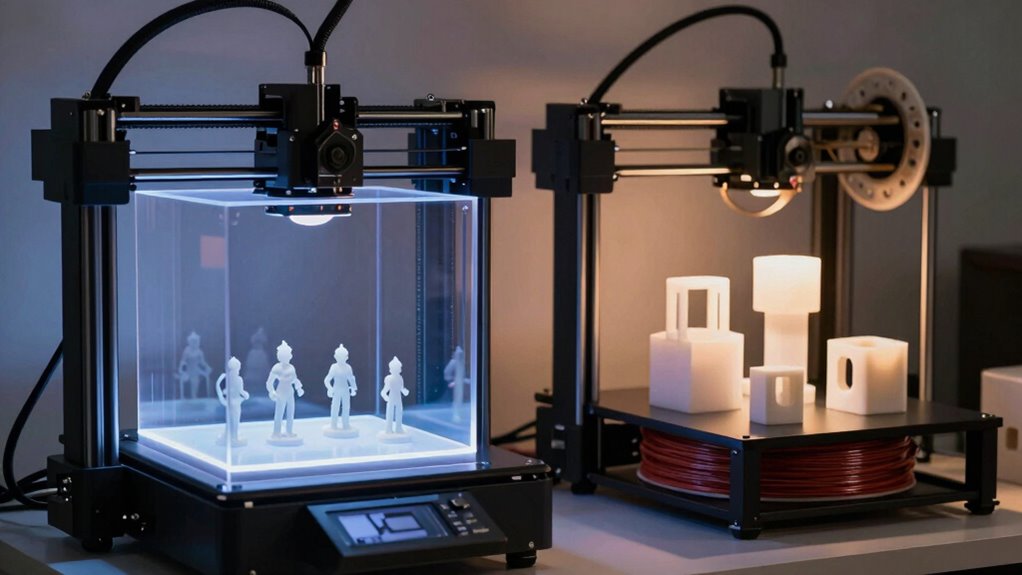

Choosing between resin and filament 3D printers depends on your project needs. Resin printers excel at detailed, small-scale models like jewelry or miniatures, but require careful handling and post-processing. Filament printers are versatile and better suited for larger projects with less intricate details, offering easier use and maintenance. Consider your desired finish, size, and complexity. Keep exploring to discover which option best fits your specific projects and workflow.

Prime made for students and young adults
- Fast, free delivery for dorm and study essentials
- Prime Video and Amazon Music included
- Member-only deals
Key Takeaways
- Resin printers produce highly detailed, smooth surfaces ideal for miniatures and jewelry, while filament printers are better for larger, less intricate models.
- Resin printing involves complex post-processing like curing and cleaning, whereas filament printing typically requires support removal and sanding.
- Resin printers require careful handling and ventilation due to resin toxicity, while filament printers are generally safer and easier to operate.
- Filament printers support common materials like PLA, ABS, and PETG, suitable for versatile, cost-effective projects.
- Choose resin for fine detail projects and filament for larger, simpler builds with easier maintenance.
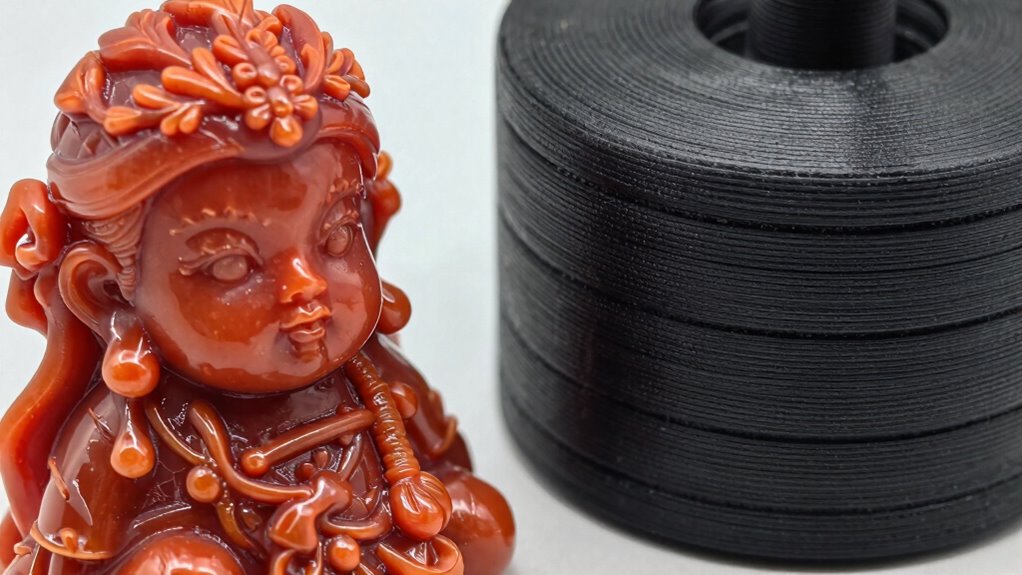
When choosing a 3D printer, understanding the differences between resin and filament options is essential, as each has unique advantages and limitations. Resin printers, often utilizing SLA or DLP technology, produce high-resolution models with smooth surfaces, making them ideal for intricate designs, jewelry, or detailed miniatures. Filament printers, commonly FDM or FFF types, are more versatile for larger projects, offering a broader range of materials like PLA, ABS, and PETG, often at a lower cost. Your choice depends on the level of detail you need and the kind of projects you want to create.
Resin printing requires careful post processing techniques to achieve the best results. After printing, you’ll need to rinse the model with isopropyl alcohol to remove uncured resin, then cure it under UV light to strengthen the final product. This extra step ensures your models are durable and have a professional finish. On the other hand, filament printing involves removing support structures and sometimes sanding or painting the parts for a polished look. Both methods demand attention to detail during post processing to avoid imperfections and ensure quality.
Maintaining your 3D printer is crucial regardless of the type you choose. For resin printers, regularly cleaning the resin vat and replacing the FEP film helps prevent print failures and ensures consistent results. Proper ventilation and handling of resin are essential for safety, as uncured resin can be toxic. For filament printers, keeping the nozzle clean and lubricating the moving parts maintain smooth operation. Checking belts and rods periodically prevents mechanical issues and extends the lifespan of your printer. Additionally, understanding the different printing technologies can help you select the best option for your needs.
When it comes to printer maintenance tips, always follow the manufacturer’s guidelines for cleaning and calibration. Proper bed leveling and nozzle checks contribute to better adhesion and fewer failed prints, saving you time and material. Both resin and filament printers benefit from a clean environment free of dust and debris, which can interfere with print quality. Additionally, storing resins in sealed containers and filament spools in dry conditions helps preserve material quality over time. Being aware of material compatibility can also improve your overall printing success.
Choosing between resin and filament 3D printers ultimately depends on your project requirements, budget, and willingness to engage with post processing techniques. Resin printers excel with detailed, small-scale models but demand more careful handling and maintenance. Filament printers offer versatility and ease of use for larger or less detailed projects with simpler post processing. Whichever you pick, staying attentive to printer maintenance tips and post processing techniques guarantees better results and a more enjoyable 3D printing experience.
Popular right now

eufy E25 Robot Vacuum and Mop Combo with HydroJet Roller Mop

Dyson V8 Cyclone Cordless Vacuum

KitchenAid Artisan Series 5-Quart Tilt-Head Stand Mixer, Dried Rose (KSM150PS)
As an affiliate, we earn on qualifying purchases.
Frequently Asked Questions
Which 3D Printer Type Is More Environmentally Friendly?
You’ll find filament 3D printers generally more environmentally friendly because they often use biodegradable materials like PLA, which break down faster. They also tend to have lower energy consumption compared to resin printers, making them a more sustainable choice overall. Resin printers produce harsher waste and require more energy for curing, so if eco-friendliness matters, filament printers are the better option for your projects.
Can Resin Printers Print Larger Objects Effectively?
Resin printers struggle with larger objects because of resin print limitations and the small build volume they typically have. You’ll find filament printers better suited for bigger projects, as they handle larger filament size constraints and can print bigger objects more efficiently. Resin printers excel in detailed, small-scale models, but for larger pieces, a filament printer offers more practicality and fewer size-related restrictions.
What Safety Precautions Are Needed for Resin Printers?
Oh, the joy of resin printing—just jump right in without safety gear, right? Not quite! You need gloves, eye protection, and proper ventilation for resin handling. Always wear safety gear to avoid skin contact and inhaling fumes. Keep your workspace well-ventilated and wash thoroughly afterward. Ignoring these precautions risks skin irritation and respiratory issues, turning your creative process into a health hazard you could’ve avoided with simple safety measures.
How Does Print Speed Compare Between Resin and Filament Printers?
Resin printers typically have slower print speeds because they rely on resin curing, which takes time for each layer to solidify. In contrast, filament printers excel at faster print speeds due to continuous filament extrusion. If you prioritize quick production, filament printers are better. However, if detail and precision are more important, the slower resin curing process might be worth the wait.
Are There Significant Cost Differences Over the Printer’s Lifespan?
You’ll find that filament printers generally have lower upfront costs, but resin printers can incur higher maintenance costs over time due to resin replacement and cleaning. Material durability varies; resin offers superior detail but can be more fragile, impacting long-term usability. Over the lifespan, filament printers tend to be more economical, while resin printers might cost more in upkeep but provide detailed, durable prints suited for specific projects.
Conclusion
Choosing between resin and filament 3D printers is like selecting a brush or a chisel—each shapes your vision differently. Resin offers intricate detail, like delicate lace woven in glass, perfect for fine art. Filament, sturdy and versatile, is your trusted hammer for bold, functional creations. Your project’s soul guides your choice—whether you seek the elegance of a crystal or the strength of steel. Ultimately, your decision carves the path to bring your ideas vividly to life.