
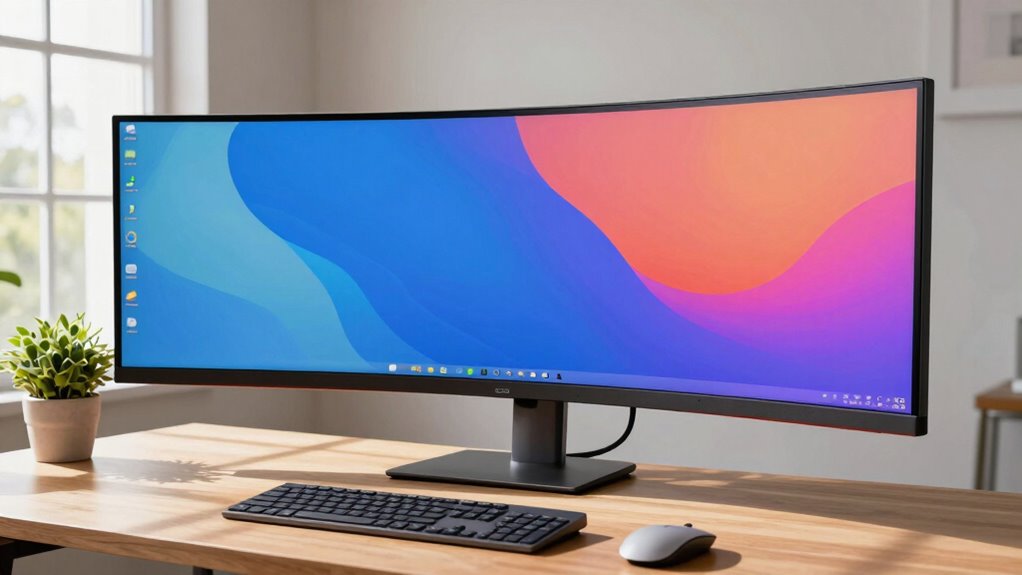

When choosing an ultrawide monitor for work, focus on color accuracy, resolution, and screen size. Look for displays with true-to-life colors and good calibration to guarantee consistency across devices. Consider higher resolutions like 3440×1440 or 3840×1600 for sharp images and more workspace. Also, check for features like IPS or OLED technology, multiple ports, and a comfortable size that fits your desk. To discover how to pick the best model for your needs, keep exploring the options available.

Prime made for students and young adults
- Fast, free delivery for dorm and study essentials
- Prime Video and Amazon Music included
- Member-only deals
Key Takeaways
- Prioritize high resolution (e.g., 3440×1440 or higher) for sharp images and ample workspace.
- Choose an IPS or OLED panel for accurate color rendering and wide viewing angles.
- Ensure the monitor has sufficient connectivity options like HDMI, DisplayPort, or USB-C.
- Consider screen size that fits your desk space while providing immersive multitasking.
- Opt for a monitor with a high refresh rate and fast response time for smooth, clear visuals during tasks.
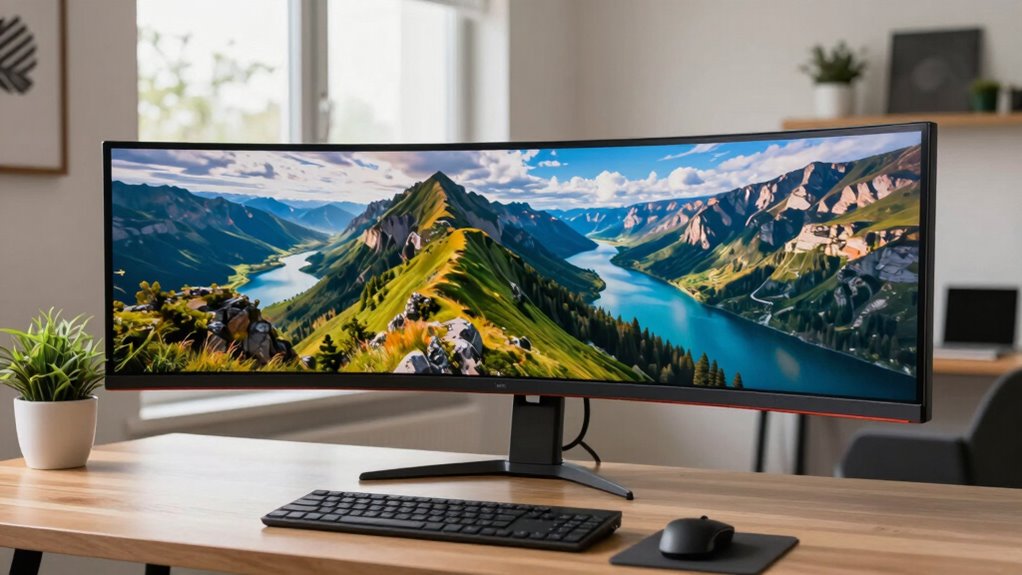
Color calibration is equally vital. A monitor with good color accuracy ensures that your images, documents, and videos look consistent and true to life. This is especially important if your work involves graphic design, photography, or any task where color precision is critical. When choosing an ultrawide monitor, check whether it supports hardware calibration or comes pre-calibrated with a wide color gamut. This feature guarantees that the colors you see on screen match print or digital standards, saving you time and frustration. The ability to fine-tune color settings also means you can optimize the display for different tasks, whether it’s editing photos or reviewing detailed spreadsheets. Additionally, color calibration ensures that your work remains consistent across different devices and viewing environments. Also, pay attention to the monitor’s color accuracy ratings, as they can give you an idea of how well the display reproduces colors in real-world use. Considering the importance of biodiversity in many fields, a monitor with precise color rendering can help in accurately assessing natural images and ecological data. It’s also helpful to consider how well the monitor maintains color consistency over time to ensure ongoing reliability.
Beyond ergonomic adjustments and color calibration, you should also consider the monitor’s resolution and screen size. An ultrawide with higher resolution, like 3440×1440 or 3840×1600, offers sharper images and more workspace. The extra width allows you to have multiple windows open side by side, which boosts multitasking efficiency. Make sure the monitor’s size is appropriate for your desk space—too large, and it may overwhelm your area; too small, and you might not gain the full benefits of an ultrawide setup. Additionally, display technology such as IPS or OLED can impact color consistency and viewing angles, further enhancing your color experience. Connectivity options are another aspect to evaluate. Look for a monitor with multiple ports—such as HDMI, DisplayPort, and USB-C—to connect your devices easily. USB-C is especially convenient because it can transmit video and charge your laptop simultaneously, reducing cable clutter. Also, consider the refresh rate and response time if you plan to use the monitor for gaming or fast-paced tasks. A higher refresh rate can make movements smoother and reduce eye strain over extended periods.
Popular right now

TCL 43-Inch 4K UHD Smart LED Roku TV (43S435, 2021 Model)

Breville Bambino Espresso Machine, Brushed Stainless Steel

Dyson Ball Animal 3 Upright Vacuum – Corded, 290 AW, De‑tangling Motorbar Cleaner Head, 3 Suction Modes
As an affiliate, we earn on qualifying purchases.
Frequently Asked Questions
What Is the Ideal Resolution for an Ultrawide Monitor?
The ideal resolution for an ultrawide monitor is at least 3440×1440 pixels, offering sharp images and ample workspace. Prioritize color accuracy if you work with visuals, ensuring the monitor supports good color reproduction. An ergonomic design also helps you stay comfortable during long hours. Higher resolutions like 3840×1600 provide even more detail, but balance this with your system’s capabilities and your workspace needs for a smooth, productive experience.
How Do I Connect an Ultrawide Monitor to My Laptop?
Did you know over 70% of users find productivity improves with the right monitor setup? To connect your ultrawide monitor to your laptop, check your device’s ports—USB-C, HDMI, or DisplayPort. Use compatible cables to guarantee a seamless connection. Once connected, adjust ergonomic settings like tilt, height, and swivel to maximize comfort. This setup enhances your workspace, making it easier to multitask and stay focused throughout the day.
Are Ultrawide Monitors Suitable for Gaming as Well as Work?
Ultrawide monitors are great for both gaming and work, enhancing multitasking efficiency and offering an immersive experience. Their large screens let you view multiple windows simultaneously, boosting productivity. For gaming, they provide wider field of view and sharper visuals, making gameplay more engaging. Just guarantee the monitor has a fast refresh rate and good resolution for smooth performance. Overall, ultrawides are versatile, making them a smart choice for both work and play.
What Is the Typical Lifespan of an Ultrawide Monitor?
A typical ultrawide monitor lasts about 5 to 10 years, depending on monitor durability and usage. For example, if you use your monitor daily for work and gaming, it might reach the lower end of that range sooner. Factors like build quality, screen technology, and proper maintenance influence lifespan. To maximize longevity, avoid static images and keep the monitor clean, ensuring it stays in good condition longer.
Do Ultrawide Monitors Require Special Graphics Cards?
Ultrawide monitors typically don’t require special graphics cards, but your existing GPU should support their resolution and refresh rate for peak performance. You’ll want to check if your graphics card can handle features like color calibration and ergonomic setup adjustments. Ensuring compatibility helps you get the best image quality and comfort, especially if you plan on long work sessions. Most modern GPUs can handle these demands, but double-check your specs to be sure.
Conclusion
Imagine yourself sitting at your desk, a seamless expanse of screen stretching out before you like a panoramic window into your work world. With the right ultrawide monitor, you’ll feel the clarity and space to breathe, to organize, to create. It’s more than a screen—it’s a gateway to productivity and focus. Choosing wisely means you’ll reveal a horizon of possibilities, turning your workspace into a vibrant, immersive landscape where your best ideas come to life.