Open a free Amazon Business account
Business pricing, bulk buying and tax-exempt orders.
As an affiliate, we earn on qualifying purchases.
Reimagining Space Operations Through Code-Generated Surfaces
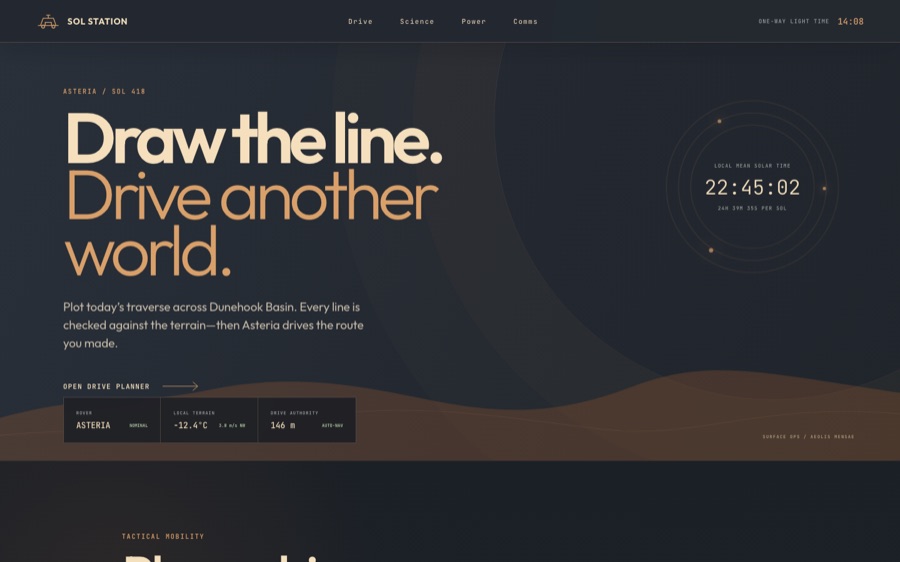
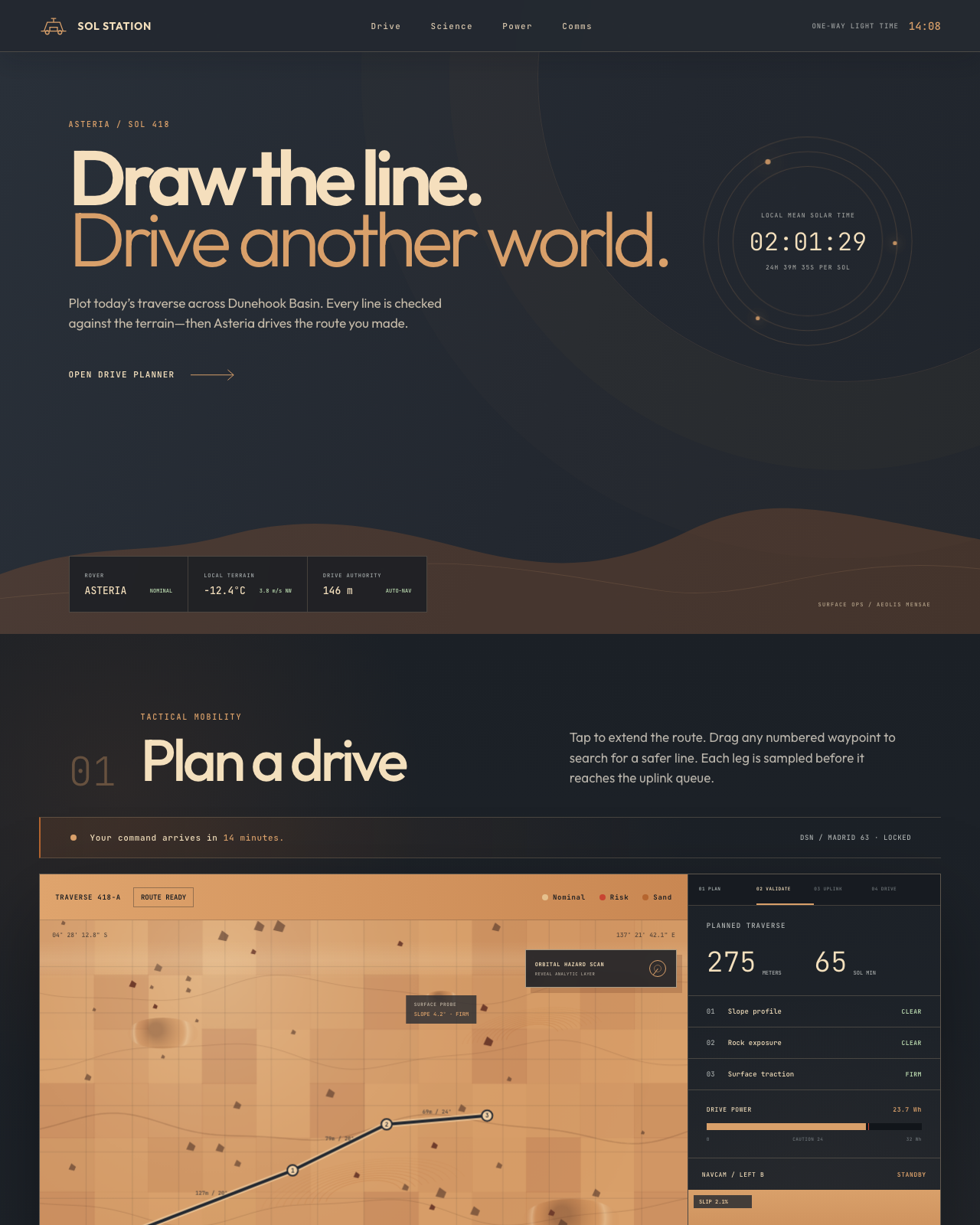
Imagine a mission control interface designed entirely through procedural code, where every terrain feature, hazard analysis, and route visualization is generated algorithmically. This AI-crafted site puts you in a calm, deliberate environment that simulates a rover crossing alien landscapes, with real-time terrain sampling, hazard overlays, and route execution—all built from a single, deterministic surface model. Its signature move? Using procedural terrain as both visual and data backbone, creating a seamless, believable experience of remote planetary navigation.
Three-Pass Development Guided by a Rigorous Review
The build process begins with constructing a deterministic terrain and hazard model through procedural code. Next, the project undergoes a merciless critique, focusing on visual consistency, data fidelity, and user interaction clarity. Finally, the art director certifies the design, ensuring it maintains a calm, believable mission atmosphere. This process is detailed in the AI-generated guide, which emphasizes code-driven visual techniques, user-centered interaction, and the importance of a unified data-model architecture.
The full build notes live in the room’s design guide.
Color, Type, and Signature Interaction in Procedural Terrain
The visual palette combines muted, earthy tones—regolith rust, butterscotch sky, slate panels, and signal cream—carefully selected to evoke calmness and clarity. Every color is generated via code, mapping terrain features and hazard severity, ensuring consistency across loads. The interface employs a restrained typography system—JetBrains Mono for data and headings, outfit for large displays—creating a clear hierarchy that balances human readability with technical precision. The core signature lies in how every visual element, from contours to hazard overlays, originates from algorithmically sampled data, avoiding static images or overlays. Instead, each terrain, hazard scan, route, and sensor output is a live, code-rendered construct. This approach not only enhances realism but also demonstrates how procedural techniques can unify data and visuals into a coherent, believable environment.
Want this? Paste this into your AI coding agent
Build a single-page showcase website from this art-direction brief. Work like an elite creative frontend engineer; commit totally to the direction.
BRIEF (room 70 of 175, “rover”):
SOL STATION — mission ops for a Mars rover. Aesthetic: ops-console calm; butterscotch sky. Palette: regolith rust #b5652f, butterscotch sky #d9a06a, console slate #232830, NASA-ish accents (no logos). Fonts: outfit (display), jetbrains-mono (telemetry). SIGNATURE: PLAN A DRIVE — a procedurally generated terrain map (craters, ripples, hazard shading) where you drop waypoints; the planner validates slope/rock hazards (segments go red), estimates power and sol time, then EXECUTES: the rover crawls your route on the map while a synthetic navcam strip renders passing terrain, wheels slipping on sand patches. Sol clock (24:39), power budget bars, downlink window countdown, drill-site cards. One-way light-time notice: “Your command arrives in 14 minutes.” Unforgettable: your own route, driven.STACK: pure HTML/CSS/JS, no build step, no frameworks, no CDNs or external requests of any kind; self-hosted fonts only; every visual is code (CSS/SVG/canvas/WebGL) — no image assets required.
QUALITY BAR: flawless at 390px, 834px and 1440px with zero horizontal overflow; tap targets >= 44px; semantic landmarks, focus-visible styles, body-text contrast >= 4.5:1; prefers-reduced-motion pauses or simplifies heavy animation; rAF loops pause when the tab is hidden; hold 60fps (cap particle counts, avoid layout thrash); rich invented content everywhere — real-sounding names, numbers and program notes, never lorem ipsum; orchestrate one beautiful staggered load moment plus scroll and hover surprises. FORBIDDEN: Inter/Roboto/Arial/system-ui, purple-gradient-on-white, and cookie-cutter hero+cards+footer layouts.
PROCESS: iterate in three documented passes — (1) build plus builder self-critique, (2) merciless external critique finding and fixing at least ten real problems, (3) art-director elevation from good to unforgettable. Screenshot at all three widths every pass and fix everything you can see.
— Original brief by Claude Fable 5 (art director), executed by the FABLE/175 pipeline.
— This room lives at https://fable-25-830.netlify.app/sites/rover/
This is the verbatim art-direction brief that produced the room — exposed by the exhibition itself via the “Prompt” link in the room’s footer.
Explore the AI-Generated Mission Control
Visit the live simulation to experience the terrain, route execution, and hazard sampling firsthand. Browse all 175 AI-crafted sites at the hub to see how procedural techniques redefine interactive space environments.
Visit the live room → · Browse all 175 rooms
Previously in Wing III
- Room 66: The Comb Works — Bees, decoded
- Room 51: Casa Azulejo — A Lisbon Tile-Painter’s Workshop
- Room 68: The Belfry | Eight Bells, Endless Changes
FABLE / 175 is a finished exhibition of 175 fundamentally different websites, each built end-to-end by an AI. This article is part of our series walking through it room by room.
planetary terrain simulation software
As an affiliate, we earn on qualifying purchases.
As an affiliate, we earn on qualifying purchases.
Grilling season Picks
grills
As an affiliate, we earn on qualifying purchases.